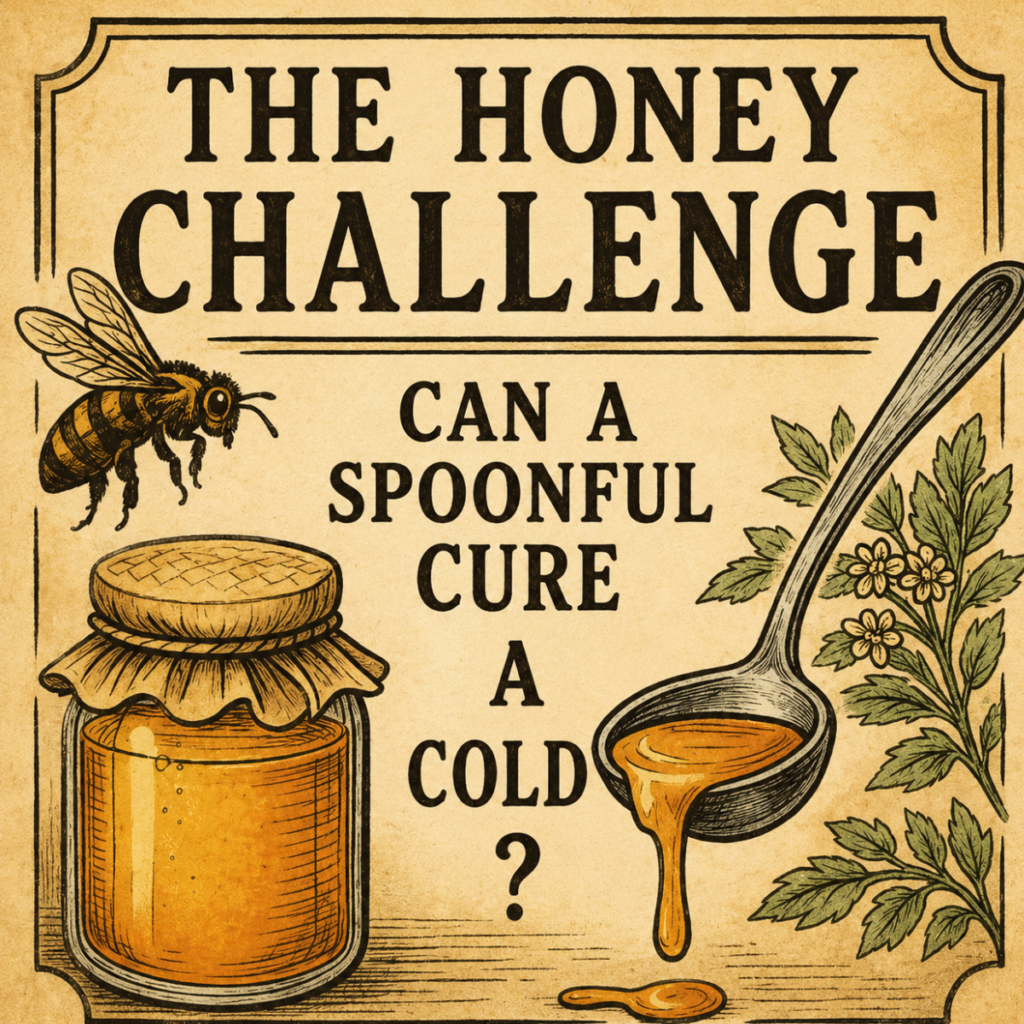
Can a simple spoonful of honey improve a cold? Discover the 7-day honey challenge that mixes science, humor, and tradition. Safe recipes, real results, and the natural secret that sweetens your winter.
The Honey Challenge: Can a Spoonful Cure a Cold?
Seven days, an amber jar, and a handful of myths. Spoiler: honey cannot give you a clean bill of health, but it may bring you more peaceful nights.
- Honey must not be given to children under 1 year old because of the risk of infant botulism.
- If you have a pollen/propolis allergy or diabetes, talk to a healthcare professional about whether honey is suitable for you.
- If you develop a high fever, chest pain, difficulty breathing, a persistent cough (>3 weeks), or worsening symptoms, seek medical attention.
- This challenge is intended to be fun and educational. It is not a substitute for diagnosis or treatment.
I. Setting Up the Challenge
Goal: to find out firsthand, over seven days, how much honey can relieve symptoms of a common cold (sore throat, nighttime cough, general discomfort), without giving it credit for feats it cannot perform. We will create a sensible routine for taking it, combined with basic self-care (rest, fluids, humidified air), and record the results using a simple scale.
Clear Rules
- Duration: 7 days.
- Take 1–2 teaspoons of honey (for adults) dissolved in a safely hot drink at night, and optionally in the morning.
- Compare it with previous days (if the cold catches you halfway through) or with your usual honey-free routine (if you start out healthy and then catch a cold).
- Avoid alcohol in “home remedies.”
Comfort Scale (1 to 5)
- 1 = throat on fire, persistent cough, interrupted sleep.
- 2 = uncomfortable, occasional coughing, restless sleep.
- 3 = manageable, breathing okay but sleeping in fits and starts.
- 4 = pretty good, sleeping almost normally.
- 5 = extremely comfortable; the cough barely shows up.
II. Challenge Diary (Seven Days with a Spoonful)
I am telling this like a logbook. It is not a clinical trial (if only I had a hundred clones!), but it is an exercise in honest observation. The point is not to “win,” but to understand what brings relief and when.
Day 1 — Declaring War on the Tickle
Cold afternoon, stubborn nose. I make the classic: hot water, honey (2 tsp), half a lemon. Slow sips by the window. My throat eases down a notch. On the scale, I go from 2 to 3. Nothing epic, but definitely welcome.
Day 2 — Trial Night
I repeat the ritual and add a thin slice of ginger. Warmth, aroma, and that feeling of a “sweet coating.” I sleep better (4). The nighttime cough still sneaks in once or twice, but I get back to sleep more quickly.
Day 3 — The Valley of the Tissues
General fatigue, but my throat seems less fussy. A small victory: I read without straying far from the humidifier. At night, honey + mild thyme. Result: 3.5 to 4. I am starting to believe in small truces.
Day 4 — Midpoint Summary
Observation: honey does not “cure” a cold, but it improves comfort, especially around bedtime. I keep up the fluids, soups, and blanket. The night is fairly kind to me (4).
Day 5 — The Humidifier’s Song
Throat almost back to normal, nose still fighting its campaign. Honey with a pinch of cinnamon, for a warm-dessert craving. I sleep 6 hours straight. I write down 4.5 (it almost feels like cheating, but the rest is real).
Day 6 — Back Out into the World
A short walk in the sun, and my body applauds. At night, I return to the simplest recipe: honey + hot water. At this point, a steady 4–5. A lingering tickle, yes. Drama, no.
Day 7 — Epilogue with a Spoonful
Final dose. The week ends with the feeling that I have had a less obnoxious cold. Did the honey cure it? No. Did it help me get through the nights more peacefully? Yes. On the scale, I finish at 4.5.
III. Friendly Science: Why Does Honey “Feel So Good”?
What Honey Brings to the Table
- Viscous texture: it coats the throat lining and may reduce the tickling sensation.
- Sweetness: it stimulates saliva production and may sometimes help modulate the cough reflex.
- With a hot drink: hydration + warmth = a comforting combination.
All of this adds up to symptom relief. It does not necessarily shorten the duration of a cold.
What It Does Not Do
- It does not “kill” colds as if they were dragons.
- It does not replace antibiotics (which, in any case, do not work against the viruses that cause colds).
- It does not prevent complications if warning signs appear.
IV. Types of Honey and Realistic Expectations
There are light honeys (acacia, orange blossom), amber honeys (wildflower), and dark honeys (forest, chestnut). The aroma and finish vary on the palate, but in this ritual, the key is the texture and the pleasure of a warm sip. Forget exotic labels for a moment and focus on:
- Known origin and locally produced if possible.
- Raw or minimally processed honey (if you enjoy that style; crystallization is normal).
- A flavor you enjoy: if you like it, you will repeat the ritual, and that is half the battle won.
V. Challenge Recipes (Safe and Tasty)
1) Basic Bedtime Herbal Tea
- 250 ml of hot water (not boiling).
- 1–2 teaspoons of honey.
- Optional: 1 tablespoon of lemon juice.
- Mix and sip slowly. Air out the room and keep the air comfortably humid.
Expected effect: a more comfortable throat and a slightly less persistent nighttime cough.
2) Rustic Thyme Tea (Mild Aroma)
- Thyme infusion (steep for 5–7 min).
- 1–2 teaspoons of honey.
Fragrant without being overpowering. The thyme adds character; the honey adds a little “blanket.”
3) Gentle Ginger (for Fans of a Friendly Little Kick)
- 3 thin slices of ginger in 250 ml of water. Steep for 5 min, then strain.
- 1–2 teaspoons of honey.
It wakes you up, warms you through, and pairs beautifully with the sweetness.
VI. Field Tests: Couch, Bedside, and On the Go
Couch Test (Afternoon)
Take slow sips while reading. Rate “throat comfort” every 20 min. It often rises by 0.5–1 point.
Bedside Test (Night)
Take it 15–20 min before bed. Track nighttime awakenings caused by coughing. The total number often decreases.
Walking Test (Morning)
Take a warm version in a thermos. Rate your voice/throat clearing while speaking. There is often less throat clearing after 10–15 min.
VII. Quick Table of Symptoms and Basic Care
| Symptom | What May Help | What to Avoid |
|---|---|---|
| Sore throat | Warm liquids, honey, humid air, resting your voice | Smoke, very dry air, shouting |
| Nighttime cough | Honey at night, elevated head position, a well-ventilated room | Alcohol, heavy dinners, excessive heating |
| Congestion | Warm steam, hot showers, saline solution | Dusty environments and sudden exposure to intense cold |
VIII. Frequently Asked Questions (FAQ)
Can a spoonful “cure” a cold?
No. It can help you feel more comfortable, especially at night. The best medicine is still time + basic self-care.
How much honey is reasonable?
1–2 teaspoons in a cup of hot drink, 1–2 times a day for healthy adults. Adjust the amount if you need to monitor your sugar intake.
Honey with alcohol “to sleep better”?
Not recommended: alcohol worsens sleep quality and offers no benefit for a cough.
Can I give it to children?
Never give honey to children under 1 year old. For older children, follow pediatric guidance and avoid alcohol in recipes.
IX. Troubleshooting During the Challenge
I Do Not Notice Any Improvement
- Review the rest of your care routine (hydration, rest, room humidity).
- Try taking it 15–20 min before bed.
- If symptoms worsen or warning signs appear, seek medical advice.
The Sweetness Bothers Me
- Reduce the amount or switch to a milder honey (acacia/orange blossom).
- Pair it with a stronger-tasting infusion (thyme/ginger) for balance.
“Rebound” Cough When I Lie Down
- Elevate your head, air out the room, and avoid excessive heating.
- Do not eat a heavy dinner. Have the honey 20 min before bed, not right as you lie down.
I Am Concerned About Sugar
- Talk to a healthcare professional if you have diabetes or follow strict blood sugar control.
- Use a smaller amount and prioritize the other sugar-free measures.
X. A Little Honey Tasting (Sensory Fun)
Set up a mini tasting at home: three small glasses of hot water and one teaspoon each of three different honeys. Smell, taste, and take notes: which one makes you feel the most “wrapped up and cozy”? Sensory preference is key if you want to keep repeating the ritual.
XI. The “Layered” Approach (Why the Whole Package Matters)
No single measure wins the game on its own; it is the layers of care that add up: warm fluids, a ventilated room, humidification, rest, light meals, and your golden spoonful. Honey alone can only do so much; honey in good company makes the journey much more pleasant.
XII. Mini Lab: Honey and Your Throat
At-home test (very simple): put a teaspoon of pure honey in your mouth, let it slowly dissolve, and swallow. Notice whether the urge to cough decreases over the next 10 minutes. Not everyone responds the same way; write down what you notice.
XIII. “Gentle Emergency” Recipe (When Your Voice Starts Complaining)
- 250 ml of hot water.
- 1–2 teaspoons of honey.
- One slice of lemon (do not squeeze it if lemon tends to give you reflux).
- Optional: steep 1 sage leaf for 3 min, then remove it.
It often helps soothe throat clearing and makes reading or talking feel less irritating.
XIV. The Fun Part of the Challenge (Without Losing Perspective)
- Keep a short diary and give stars to the “cup of the day.”
- Try a different variation each night and rate the taste/effect.
- Rediscover the power of stopping for 10 minutes each day to take care of yourself.
XV. Final Results (What I Learned from a Spoonful)
After seven days, the conclusion is simple and modest: honey does not cure a cold, but the combination of honey + hot drink + ritual makes the nights easier to get through and sore throats a little less dramatic. The comfort score went up, and so did my mood. Sometimes, that is enough to feel like a cold is not running your entire week.
XVI. Epilogue from the Mad Apothecary
“There are no universal elixirs, but there are spoons with impeccable timing. When winter starts barking, a sweet cup will not silence the wolf, but it can teach it to whisper.”
Tags
natural challenges honey cold home remedies herbal tea rest self-care the secret herbalist
Don’t miss the latest posts from the Secret Herbalist, made-up news with a hint of truth to have a good time!