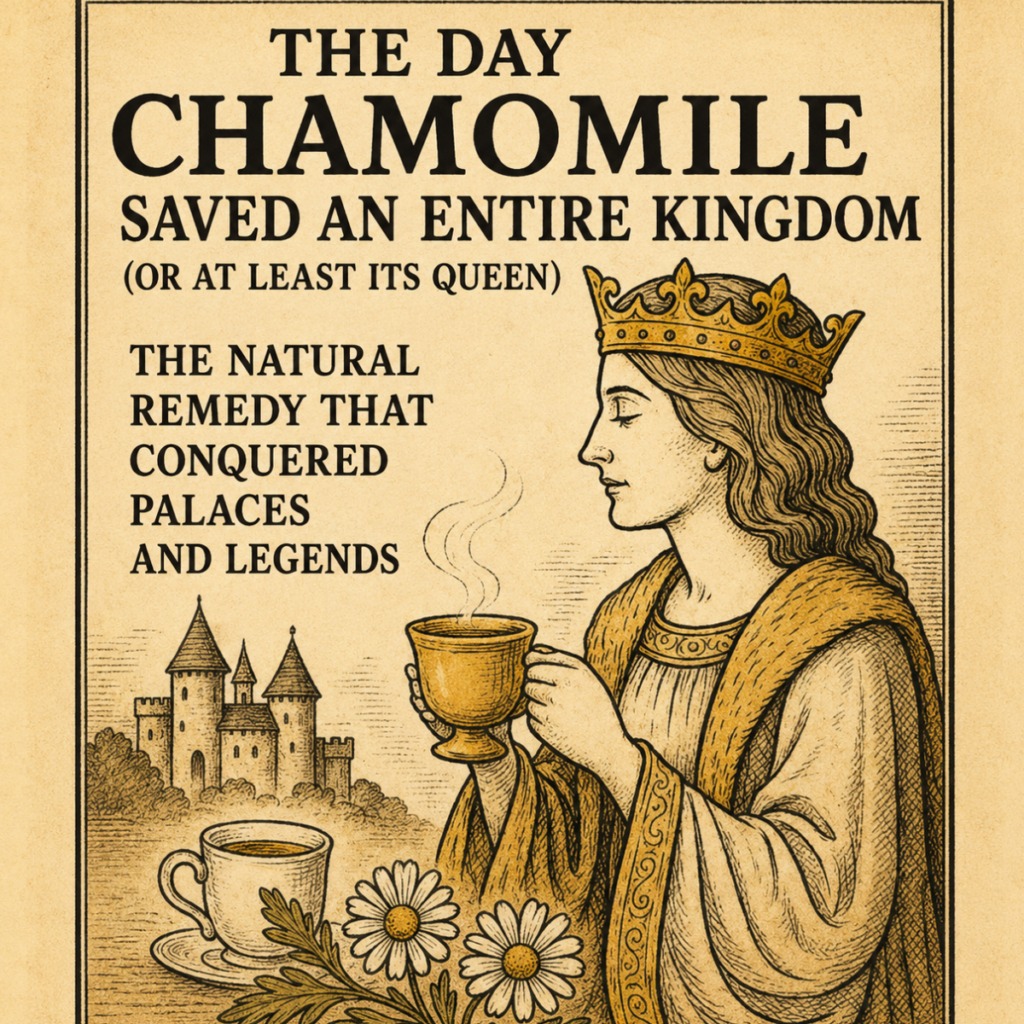
The day chamomile saved an entire kingdom: the natural remedy that conquered palaces and legends.usión que calmó a una reina… y cambió la historia.
The Day Chamomile Saved an Entire Kingdom (or at Least Its Queen)
An epic chronicle featuring humble flowers, court protocol, homemade science, and an aromatic ending.
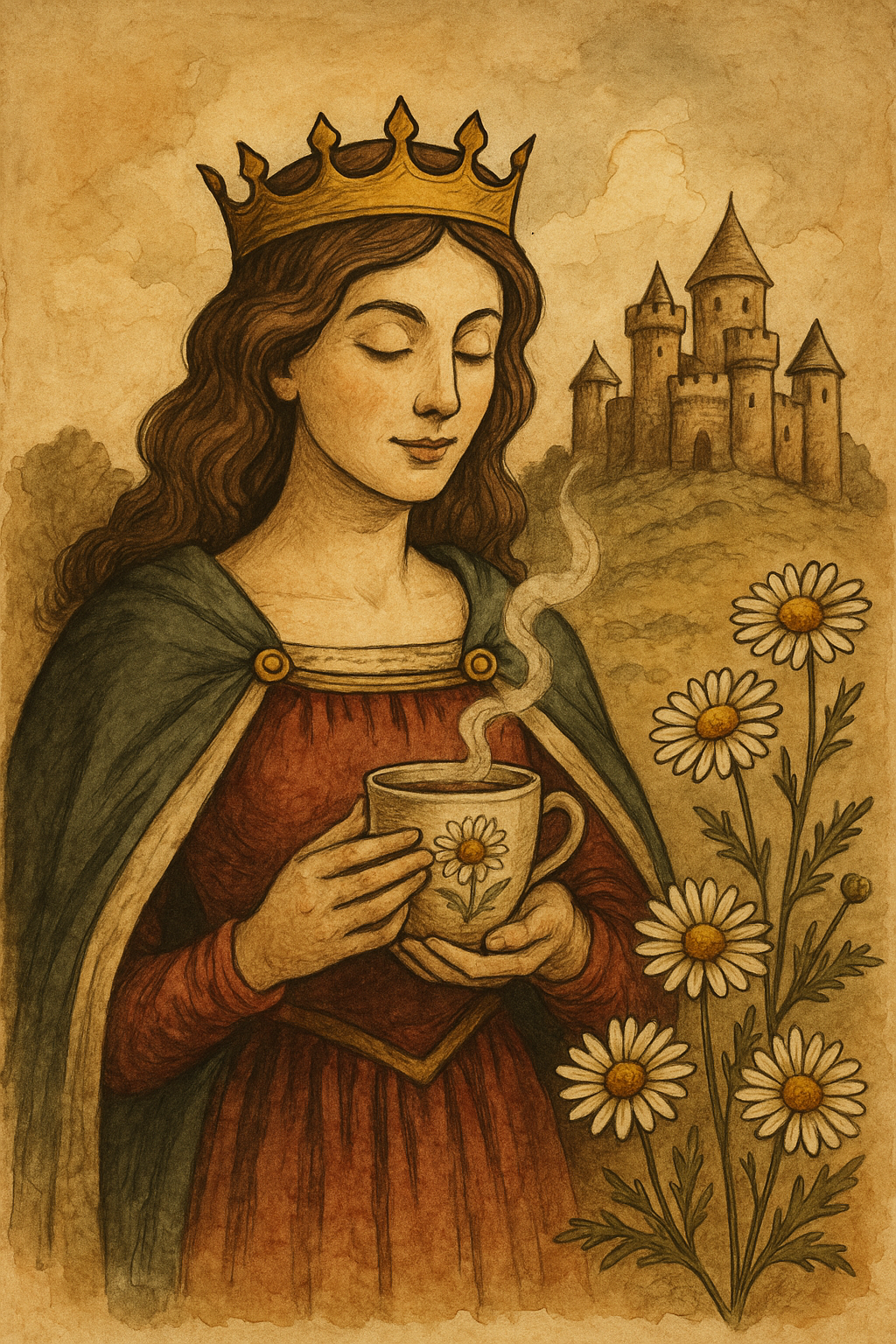
I. Prologue to the Storm: Queen, Court, and Whispers
The kingdom had been on edge for weeks. The queen—who had a gift for governing but very little patience for banquets—had endured several nights of poor sleep and digestion worthy of a farce. The chancellor proposed remedies with impressive Latin names, the abbess suggested prayer and silence, and the captain of the guard, who understood swords but not stomachs, offered to escort some famous physician from a distant land.
Meanwhile, in the palace kitchen, the fires never went out. There lived María del Azafrán, head cook, diplomat without a title, and owner of the era’s most frequently repeated saying: “A hungry queen means a Council in flames; a queen with a stomachache means a kingdom in ashes.” She was the one who, seeing the court tangled in theories, gave the order:
“Bring me the box of herbal teas. Today, the humblest flower will rule.”
II. The Preparation Ritual: Anatomy of a Cup That Silences a Room
We could dispense with all this in a three-line recipe, but gestures matter. Chamomile, like so many home remedies, does as much through what it represents as through what it is: a pause, warmth, a clean fragrance, the promise of calm.
The Cook’s Table
- Dried chamomile flowers, the color of faded sunlight.
- Clean water, freshly brought to a boil.
- Light honey (optional), to sweeten the mood of those with a fondness for sweets.
- A golden goblet—not essential, but the court does love a bit of theater.
María warms the goblet with water, empties it, adds the flowers, pours in fresh hot water, and lets them steep for 5–7 minutes, covered with a cloth so as not to break the spell.
The Hallway of Silence
The cup travels through stone corridors. Guards step aside, counselors rise onto their toes. There are no fanfares or drums—only steam and a fragrance that seems to open windows in the middle of winter.
No one knows it yet, but that journey will be remembered as the most peaceful procession in the kingdom’s history.
III. What Happens in the Palace… and in a Stomach
The queen takes a sip. She breathes. Another sip. A sigh. The chancellor steps forward with a list of decrees; she raises one hand. “Later,” she says, and for the first time in days, she smiles. Outside, the pages spread the news with the speed of people who know that any small moment of calm can turn into a general truce: “Her Majesty is feeling better.”
The Plausible Part (Homemade Science)
- The warmth can ease abdominal tension and support digestion.
- The gentle aroma can encourage a sense of rest and reduce feelings of unease.
- The simple act of drinking slowly creates a rhythm that encourages calm.
Sometimes a cup is more than a cup: it is a small ritual for returning to yourself.
The Fabulous Part (and the Fun Part)
- “It saved the kingdom”: let us interpret that as a metaphor for the collective mood.
- “A miraculous deed”: the magic here lies in the shared pause.
- “A royal flower”: what was truly royal was the serenity it inspired.
IV. The Mad Apothecary’s Report to the Council Chamber
“Your Excellencies: I have observed a direct correlation between the consumption of a hot herbal infusion and a reduction in the depth of Her Majesty’s frown. I therefore propose establishing the Chamomile Protocol for every crisis: boil water, perfume it with golden flowers, and wait until the kingdom begins beating once again to the rhythm of a cup.”
The Council Chamber, not immune to the charms of rising steam, approved the proposal by simple majority. The chancellor requested that the official record state that every important decree should be preceded by a round of herbal tea. From that point onward, the records show somewhat less heated decisions and banquets more moderate in both their courses and discourse.
V. The Geography of a Kingdom at Peace
The town squares fill with merchants, minstrels dust off their less tragic repertoire, and farmers return to arguing—politely—about the size of their pumpkins. If chamomile “saved” anything, it was the kingdom’s ability to look at itself without growling.
At the palace, the queen resumes her audiences. Whenever a dispute arrives, she glances toward the side table: several cups are waiting there. The petitioners drink, and by the time they finish, many discover that the matter was not quite as terrible as it had seemed. Inspired, the scribes christen the table The Altar of Small Peaces.
VI. A Field Manual for Heralds, Cooks, and Other Diplomats
For Heralds
- Before proclaiming the news, moisten your voice with an herbal infusion. It may prevent unnecessary exaggeration of tragedies.
- If the people grow restless, breathe, sip, and repeat the message with pauses. Calm can be contagious.
For Cooks
- Reserve a drawer for herbs both noble and humble. Chamomile belongs at the front.
- Warm the cup before serving. Details matter—and so does the palate.
For Counselors
- Include steeping time on the agenda. Five minutes may save three arguments.
- Remember: less Latin, more sipping.
VII. The Court’s Official Recipe (Home Edition)
Golden Chamomile Tea
- Heat 250–300 ml of water until it reaches a gentle boil.
- Add 1–2 tablespoons of dried chamomile flowers to a cup or filtered teapot.
- Steep for 5–7 minutes. Keep it covered so the aroma does not escape.
- Sweeten with honey (optional), or drink it as is. Serve without rushing.
Expected effect: the stomach stops waving battle flags, and the tongue remembers how to say, “We’ll deal with that later.”
VIII. The Patient Scribe’s Botanical Appendix
Chamomile—that tiny wheel of sunlight—grows along roadsides, in gardens, and in stubborn little flowerpots. It is forgiving of clumsy gardeners and generous toward those who barely tend it. The palace gardeners, following the queen’s orders, dedicated a garden bed to the flower of the peaceful decree and placed a bench beside it. From then on, important councils were held there on mild days.
They even established the Garden of Conversation, devoted to discussions that did not attempt to fix the world in a single minute. The bees, honorary diplomats, contributed their hum of consensus.
IX. The Opposition and the Cup
Not even the fiercest opposition could resist its liquid charm. It is said that one particularly hot-tempered leader demanded to speak “without flowers.” The queen, attentive but firm, tilted her head slightly toward the steaming cup. The man drank, cleared his throat, sat down, and said, “Let’s start again.” Minutes signed, tension returned to reasonable levels. Chamomile did not win debates, but it helped the losers leave with dignity.
X. Village Chronicles: The Legend Travels
Villages, always quick to recognize something useful, adopted the custom. Inns advertised a “royal cup” on their chalkboards; markets sold bundles of dried flowers tied with string; grandmothers reclaimed their titles as ministers of everyday life. Children learned that before an impossible exam, a little sip could make the world seem the right size again.
The minstrels exaggerated, of course. In their poems, chamomile soothed volcanoes, brought sailors home, and persuaded dragons to become vegetarians. No one entirely believed them, but no one minded hearing the story after dinner.
XI. A Practical Guide to Serenity (For Use Outside the Palace)
The Five-Minute Protocol
- Boil water. Add flowers. Cover. Wait.
- While it steeps, write your worry down on a piece of paper.
- Drink slowly. Read what you wrote. Ask yourself: “Does it still feel that big?”
The After-Dinner Protocol
- One cup per person. One person speaks at a time. One moment of silence between sentences.
- If someone raises their voice, raise the teapot. That is usually enough.
XII. The Realist’s Minor Objections
“But it cannot cure wars,” says the realist. True. Nor can it repair bridges or uncover buried treasure. What it does—and this is no small thing—is remind decision-makers that they are tired mammals with a tendency to dramatize when they are hungry, sleepy, or afraid. Chamomile is a drinkable reminder of that condition.
XIII. An Inventory of Sayings Born from a Cup
- “We’ll talk about it in the garden, with the golden flower.” = postponing an argument with elegance.
- “Before the decree, the tea.” = order matters.
- “Bring two cups. This one concerns two people.” = acknowledging that the other person has a volcano of their own.
XIV. The Farmer’s Letter
“Your Majesty: we may not understand treaties out here, but we do understand droughts. Chamomile did not make it rain, but it did teach us to wait with less noise. And in the meantime, when the downpour finally came, we were peaceful enough to celebrate it.”
XV. Small Decrees with Greater Effects
Arguing while standing was prohibited. A reasonable nap after official lunches was established. Schedules were published with time set aside for walks; funds were allocated for benches in sunny public squares. Chamomile did not appear in the official documents, but everyone knew it was behind them, smiling from inside the cup.
XVI. From the Kitchen: Variations on the Golden Flower
Country Version
Chamomile + a strip of lemon peel. Steep for 5 minutes. The aroma of a countryside freshly combed.
Nighttime Version
Chamomile + a pinch of lavender. Drink while wrapped up warmly. Speak in the soft voice of a blanket.
Audience Version
Chamomile alone, served in a warm cup. Two sips before speaking, one after listening.
XVII. The Day After the Modest Miracle
Dawn breaks beneath an ordinary sky. No signs in the heavens, no trumpets. The queen eats breakfast with an appetite, the council applauds without making a spectacle, and the city yawns contentedly. With no sensational headline to announce, the town crier declares: “The market is open again today, and the fruit is sweet.” The kingdom learns that peace rarely arrives on horseback; more often, it enters through the nose on a trail of steam.
XVIII. Exegesis by the Pedantic Scribe (In Case Anyone Asked)
The story of the chamomile that “saved a kingdom” works as a parable about small policies: the kind that do not change maps but do change days. Literature is filled with great horses and little cups; I suspect the latter have won more invisible battles than we realize.
XIX. The Herbalist’s Mini Glossary
- Golden flower: the courtly name for chamomile in this story.
- Altar of Small Peaces: a table with herbal tea where people can talk things through more calmly.
- Chamomile Protocol: an officially sanctioned pause before making decisions that might otherwise keep you awake at night.
XX. How to Tell This Story So It Works (A Modern Minstrel’s Guide)
- Begin with a kingdom in trouble; exaggeration keeps the plot moving.
- Introduce a cook with more wisdom than titles.
- Describe the steam: people like to smell things with their imagination.
- Finish with small measures: benches in the sun, reasonable naps, pauses over a cup.
XXI. Epilogue in the Garden of Conversation
Tags
chamomile natural remedies the time herbalist history and myth medieval queen herbal teas domestic diplomacy secret herbalist
NDon’t miss the latest posts from the secret herbalist