Discover the story behind Poppaea Sabina’s legendary milk and honey baths, one of ancient Rome’s most natural and indulgent beauty rituals. Learn how to recreate one at home, what it can do for your skin, and the myths, history, and traditions surrounding it.
Sometimes, the simplest things make the best beauty rituals. I remember one afternoon, while looking for natural ways to care for my skin, I stumbled across a story that instantly caught my attention: Poppaea Sabina’s famous milk and honey baths. She was the wife of Emperor Nero.
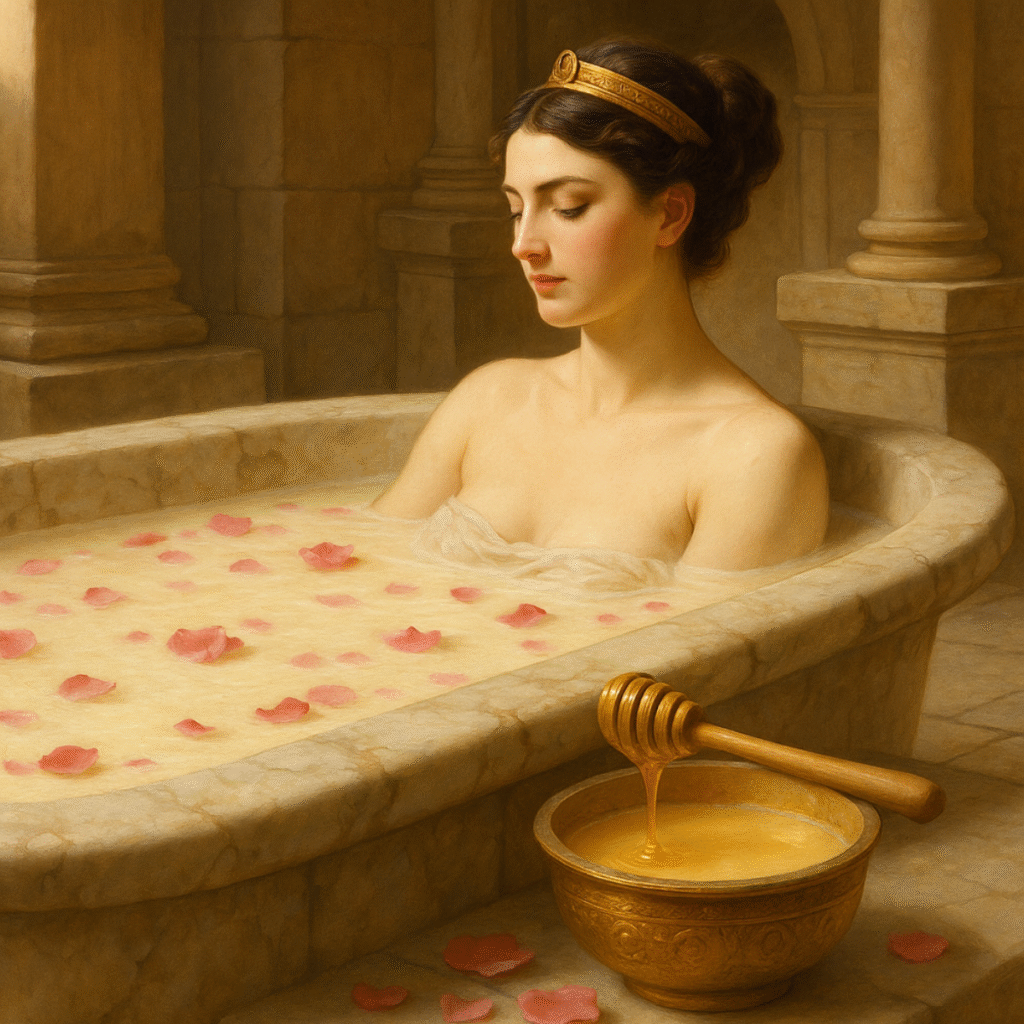
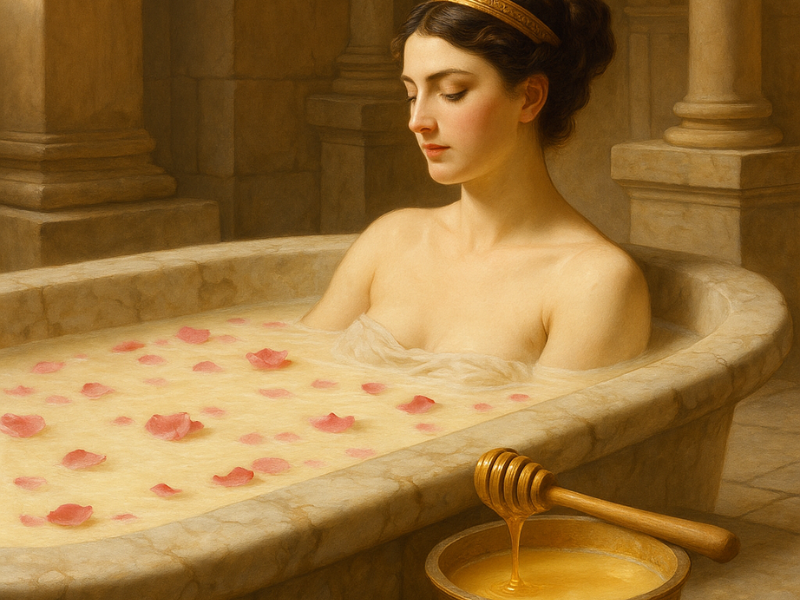
Legend has it that she had some of the most radiant skin in Rome, so soft it was compared to silk, and that her secret was bathing in a mixture of fresh milk, pure honey, and flower petals. At first, I thought it sounded a little far-fetched, but the more I read, the easier it was to understand why this beauty ritual has fascinated people for centuries.
These baths were about much more than beautiful skin. They were also a chance to slow down, relax, and enjoy a little time to yourself. And the more I think about it, the more I suspect Poppaea wasn’t only chasing flawless skin. She was probably drawn to the sense of comfort and well-being that comes from taking time to care for yourself.
Poppaea Sabina and her passion for beauty
Poppaea Sabina was one of the most intriguing women of the Roman Empire. Born into a noble family, she was described by ancient writers as intelligent, elegant, and exceptionally beautiful.
Her complexion was said to be so fair and smooth that it almost seemed to glow, and she went to great lengths to keep it that way. Of all her beauty rituals, one became particularly famous: her milk and honey baths.
Ancient writers such as Pliny the Elder claimed that Poppaea Sabina traveled with female donkeys so she would always have a supply of fresh milk wherever she went. It sounds wildly extravagant now, but in imperial Rome, beauty was closely tied to status and power, and Poppaea certainly seems to have understood that.
But there was more to it than luxury. Long before modern skincare existed, women relied on ingredients they could find in nature. Milk and honey weren’t simply an extravagant combination; they were used as a genuine form of skin care.
Myths, legends, and curious details
Plenty of stories grew up around Poppaea Sabina. Some claimed her skin was so delicate that even the sun barely touched it. Others said she added rose petals, rare oils, and even powdered pearls to her baths.
According to legend, she could spend hours soaking in warm milk while servants added honey to the bath and scented the room with incense and jasmine. It’s easy to picture the scene: luxurious, theatrical, and almost ceremonial.
Some stories even suggest that Poppaea believed milk could cleanse the spirit as well as the skin. It’s hard to separate fact from legend after so many centuries, but what is clear is that milk and honey have remained popular beauty ingredients for a very long time.
And today, we know there are good reasons these ingredients became so popular. The nicest part is that you only need a few simple things to bring a little of that Roman-inspired luxury into your own bathroom.
What makes milk and honey so good for the skin
I’ve always loved how some of the simplest ingredients in nature can be surprisingly useful. Milk and honey may sound like an old-fashioned beauty remedy, but there are practical reasons they have been used in skin care for so long.
What milk can do for your skin
Milk contains lactic acid, a naturally occurring acid that gently exfoliates the skin by helping to loosen dead skin cells, leaving it feeling smoother and looking brighter. It also contains vitamins A, D, and E, along with proteins and minerals. The natural fats in milk can help soften dry skin and support its protective barrier, leaving it feeling comfortable and nourished rather than greasy.
What honey can do for your skin
Honey is one of those ingredients that fits beautifully into a simple skincare routine. As a humectant, it helps draw moisture into the skin and keep it there. It is also known for its antioxidant and naturally antibacterial qualities, and it can help leave dry or irritated skin feeling calmer, softer, and more comfortable.
Put the two together and they complement each other nicely: the milk gently exfoliates and softens, while the honey helps keep the skin moisturized. Add the warm scent and creamy texture, and an ordinary bath suddenly feels much more luxurious.
How to make a Poppaea Sabina-inspired milk and honey bath
If you’d like to try it for yourself, you really don’t need much. It’s an easy ritual to save for a quiet afternoon or evening when you feel like slowing down and giving yourself a little extra care.
Ingredients
- 2 liters of whole milk (cow’s milk, goat’s milk, or a fortified plant-based alternative).
- 3 tablespoons of pure honey.
- 2 tablespoons of sweet almond oil or extra virgin olive oil.
- A handful of rose petals or lavender (optional).
- 10 drops of geranium or lavender essential oil (optional).
How to prepare it
Gently warm the milk without bringing it to a boil. Add the honey and stir until it has dissolved, then mix in the oil. If you want a stronger fragrance, you can add the essential oil at this point too.
Pour the mixture into a bathtub filled with warm water and give it a gentle stir. Step in slowly, get comfortable, and give yourself permission to do absolutely nothing for a while.
Close your eyes, breathe, and let the warm water do its job. After about twenty minutes, rinse your skin with warm water and gently pat yourself dry rather than rubbing with a towel. Your skin should feel noticeably softer straight away.
How to adapt it for your skin type
Everyone’s skin is different, so you can easily tweak the basic recipe to suit what yours needs.
Dry skin
Add an extra tablespoon of oil and a little more honey for a richer, more moisturizing bath. Your skin should feel especially soft and silky afterward.
Oily or combination skin
Try using skim milk and adding a teaspoon of apple cider vinegar or a few drops of tea tree essential oil. Keep the mixture simple and avoid adding too much oil.
Sensitive skin
Use oat or coconut milk instead of dairy milk and leave out the essential oils. You can also add a tablespoon of finely ground oats or oat flour for an extra soothing touch.
How to store the ingredients and leftover mixture
Milk and honey are natural ingredients, so this is one of those recipes that is best made fresh. If you do have any mixture left over, keep it refrigerated and use it within two days.
Pure honey keeps extremely well when stored in a tightly sealed container away from moisture, but once it has been mixed with milk, the mixture becomes perishable and needs to be treated accordingly.
If you want to get things ready in advance, prepare the other ingredients first and add the milk just before you plan to use the bath.
Benefits of a milk and honey bath
One of the things I like most about this kind of bath is how quickly you notice a difference in the way your skin feels. It’s simple, but the results can be surprisingly satisfying.
Some of the most noticeable benefits are:
- Softer, more moisturized, supple-feeling skin.
- A smoother, brighter-looking complexion.
- Skin that feels calmer and less irritated.
- An immediate sense of comfort and relaxation.
- A warm, soothing, spa-like experience.
But for me, the appeal goes beyond what it does for your skin. There’s something about taking that time for yourself, sinking into warm water, smelling the honey, and feeling your whole body unwind. That moment of calm is part of the ritual too.
The symbolism of milk and honey
Milk and honey have been associated with abundance and purity since ancient times. In the Bible, the Promised Land is famously described as “a land flowing with milk and honey.” In ancient Egypt, both ingredients were also used in offerings and rituals connected with renewal.
In Rome, milk was associated with youth and purity, while honey carried associations with sweetness and longevity. So it’s easy to see why the two ingredients became part of such an elaborate beauty ritual. For someone like Poppaea, a bath like this may have been as much about status and symbolism as it was about skin care.
Similar beauty rituals in other cultures
Poppaea may be famous for her milk baths, but she certainly wasn’t the only historical figure associated with them. In Egypt, Cleopatra is also said to have bathed in donkey milk to keep her skin soft and youthful. In ancient Greece, honey and oils were commonly used as part of beauty and body-care rituals among wealthy women.
In India, milk and honey have also been used in traditional pre-wedding beauty treatments to help leave the skin looking fresh and radiant. I find it fascinating that very different cultures arrived at such similar combinations of simple, natural ingredients.
Frequently asked questions
Can I use plant-based milk?
Yes. Oat or coconut milk both work well and can be a gentler option, especially if your skin is sensitive.
What if I don’t have a bathtub?
That’s not a problem. You can apply the mixture to your skin with a soft sponge in the shower, or use a smaller amount to make a relaxing foot soak.
How often can I take a milk and honey bath?
Once or twice a week is plenty. Think of it as an occasional treat rather than something you need to do every day.
Can I add other ingredients?
Absolutely. Oats, aloe vera, or a few drops of rosehip oil are all lovely additions, depending on what your skin needs.
The first time I tried a milk and honey bath, I honestly wasn’t expecting much. It was winter, my skin was dry, and I desperately needed a little downtime. I warmed the milk, stirred in the honey and oil, lit a few candles, and eased myself into the bath.
It felt wonderful, but what surprised me most was how I felt afterward. My skin was incredibly soft, of course, but I also felt deeply relaxed, almost as though my body and mind had finally caught up with each other.
Since then, I’ve come back to this ritual whenever I need to switch off for a while or my skin feels particularly dry and tired. It’s simple, comforting, and a nice reminder that taking a little time for yourself doesn’t have to be complicated.
Poppaea Sabina’s milk and honey baths are more than an old beauty recipe. To me, they’re a reminder that self-care can be simple, sensory, and genuinely enjoyable.
You don’t need a palace or a household full of servants to recreate the feeling. A little time, a few basic ingredients, and the chance to switch off for a while are more than enough.
In a world where everything seems to move at full speed, taking a long bath can feel almost rebellious. It’s a small way of saying, “I’m taking some time for myself today. No rushing, no noise, just a little peace and quiet.” And when you step out of the bath, chances are your skin won’t be the only thing that feels better.
Have you ever tried a milk or honey bath? Would you add a natural beauty ritual like this to your routine? Let me know in the comments. I’d love to hear about your experience and swap ideas for making everyday self-care feel a little more special.