Discover the centuries-old beauty ritual of the Yao women, famous for their extraordinarily long, strong hair. Learn how to make fermented rice water step by step at home.
Have you ever stared at a photograph and thought that what you were seeing couldn’t possibly be real? That’s what happened to me the first time I saw the women of the Yao ethnic group in the village of Huangluo, in China. Picture hair over six feet long, glossy as jet, strong as silk rope, and, most remarkable of all, barely a gray hair even on women in their eighties.
I’ll admit I was skeptical at first. We’re so used to being sold the latest serum with unpronounceable molecules that when somebody tells you the secret is something as humble as the water you rinsed your rice in, you want to laugh. But my curiosity beat my skepticism, and today I want to take you along on this journey. It isn’t just a recipe, it’s a philosophy, a respect for natural cycles and a gift these women have kept for centuries.
A journey to Huangluo, where hair is the soul
To understand why rice water works, we first have to understand where it comes from. Huangluo isn’t just any village. It’s known around the world as the village of the longest hair, recognized by Guinness World Records. But for Yao women, their hair isn’t a trophy for television. It’s their most sacred possession.
In their culture, long hair symbolizes longevity, wealth and good fortune. They cut it only once in their lives, at eighteen, in a ceremony marking their passage into adulthood. That cut hair isn’t thrown away. It’s kept and woven together with the new growth into spectacular styles that signal whether a woman is married, has children or is looking for a partner.
What fascinated me most when I started reading about them is that they don’t use chemical shampoos. Not one. Everything that touches their heads comes from the land. Their washing ritual is communal, on the banks of the river, and the star of it is a whitish liquid with a distinctive smell that they prepare with the patience of craftswomen.
What exactly is fermented rice water
A lot of people make the mistake of thinking it’s enough to cook some rice and pour the water over your head. If only it were that simple, but the magic lies in the fermentation.
When rice is soaked and the water is then left to ferment, the pH drops. Plain rice water sits around neutral, and fermenting it brings it down into the mildly acidic range, which is much closer to the natural pH of hair and scalp. That matters, because a slightly acidic rinse helps the cuticle lie flat, which is what traps moisture in and makes hair reflect light like a mirror.
You’ll see this compared online to Pitera, the star ingredient in some famously expensive luxury skincare. I’d love to tell you the Yao women have that for free in their kitchens, but I’d rather be accurate with you: Pitera is a trademarked name for a very specific yeast ferment filtrate, produced under controlled conditions with one particular strain. What you make at home is a different thing entirely. It’s still a nutrient-rich ferment and it still does lovely things for hair, but it isn’t the same substance, and anyone telling you otherwise is stretching it.
The properties that might make you forget store-bought products
If you’re reading this, it’s probably because your hair has lost some of its spark. Maybe it feels dry, maybe it’s stuck at one length and won’t grow past it, or maybe you’re simply tired of reading ingredient lists that look like an organic chemistry exam. Let me explain why this is different from anything you’ve tried.
Inositol, the invisible repairer
Rice water is rich in inositol, a carbohydrate with a rather remarkable property. Research suggests it penetrates the hair fiber and stays there even after rinsing, acting as a protective shield that works from the inside. If you have split ends or brittle hair from heat styling, inositol is your friend. This is the one part of the rice water story with actual laboratory work behind it, which is why I lead with it.
Amino acids for structure
Our hair is made of protein, and protein is made of amino acids. Washing with this ferment gives it some of the building blocks it needs. I’ve noticed that after a month of consistent use my hair feels heavier, in the good sense. More body, more density.
B vitamins, vitamin E and minerals
Rice releases B vitamins during fermentation, along with vitamin E, a natural antioxidant, and minerals like magnesium and zinc that can soothe an irritated scalp. Being honest about the amounts, though: these are modest quantities, not a concentrated treatment. The real benefit of rice water is structural rather than nutritional.
The ritual in your kitchen: how to make it step by step
Making this is an exercise in patience. Don’t see it as another chore, see it as the first step in your new self-care ritual. When I do it, I use the time to put my phone down and focus on the smell and the process. It’s almost meditative.
What you’ll need
- Organic rice: short grain or jasmine if you can. Organic matters here, because we don’t want pesticide residue fermenting on our heads.
- Pomelo or mandarin peel: the Yao use Chinese pomelo. At home, mandarin or orange works beautifully. The oils in the peel help cleanse the scalp and bring a citrus note that balances the smell of fermentation.
- Fresh ginger: a small piece. It’s warming and stimulating on the scalp.
- Clean water: if your tap water is heavily chlorinated, use filtered or bottled.
- A clean glass jar, ideally one you’ve rinsed with boiling water first.
The process, with no shortcuts
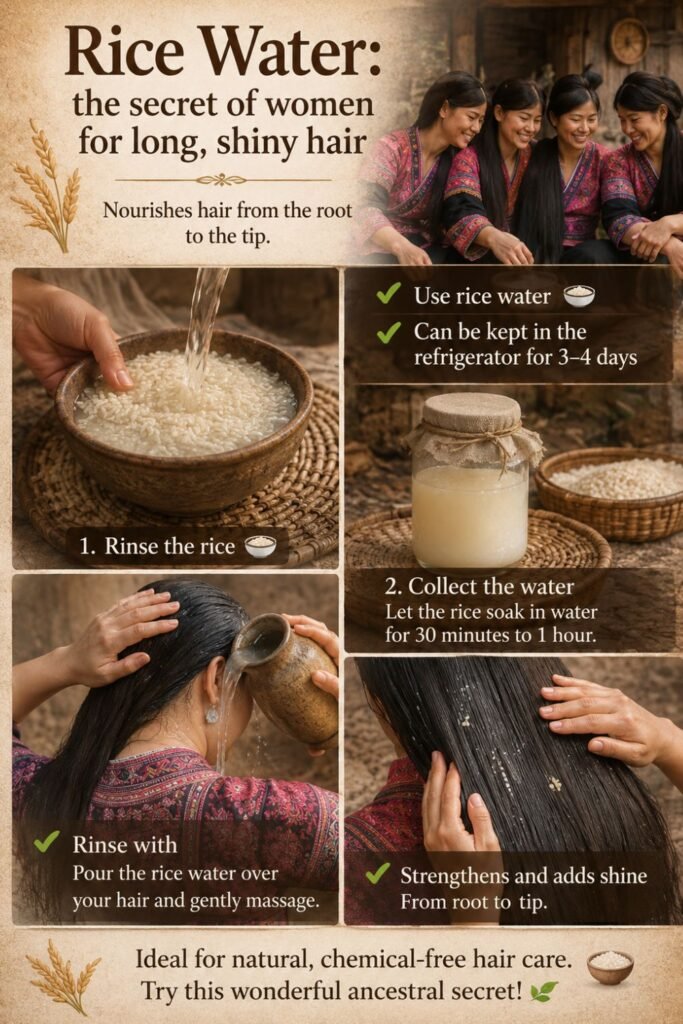
- The first rinse: put half a cup of rice in a bowl and add water. Swirl it around and throw that first water away. We only want to remove surface dust.
- The extraction: add two cups of clean water to the rinsed rice. Now use your hands. Massage the rice, squeezing it gently between your fingers. You’ll see the water turn a dense milky white. That white is the treasure we’re after.
- The gentle simmer: pour that white water into a pot, leaving the rice behind (you can cook the rice and eat it). Add the citrus peel and sliced ginger. Bring it to a boil and let it simmer gently for five to ten minutes, so the oils from the fruit blend into the starchy liquid.
- The fermentation: let the mixture cool and transfer it to your glass jar. Cover it loosely, not sealed tight, because fermentation produces gas and a sealed jar can build pressure. Leave it somewhere dark at room temperature for 24 to 48 hours. In a cold house it may take a little longer. You’ll notice the smell change, turning slightly sour. That means it’s working.
- Stopping the process: once it’s fermented, put it in the refrigerator. The cold halts fermentation and keeps the mixture usable for about a week.
One honest note about this step, since we’re leaving a starchy liquid at room temperature for a couple of days. Use a clean jar, keep it out of direct sun, and trust your nose. Pleasantly sour like yogurt or kombucha is what you want. Putrid, cheesy or musty is not, and neither is any fuzzy film on the surface. If you get either, pour it out and start again. It costs almost nothing to make, so there’s no reason to gamble.
How to use it
I’ve seen people pour rice water on and leave it in all day. Mistake. Rice water is full of protein and starch. Overdo it and hair can turn stiff and straw-like, which is what we call protein overload. The Yao approach is to use it as a rinse-out treatment with massage.
Here’s how I do it. After my usual wash with a gentle shampoo, I pour the rice water (taken out of the refrigerator a while beforehand so it’s at room temperature) over my head. I put on a shower cap and wait about twenty minutes, massaging my scalp during that time. I can feel the ginger working and my hair getting heavier and more elastic. Then I rinse thoroughly with warm water. You won’t need conditioner afterward, you’ll see how easily it detangles.
How often should you do it
If your hair is very dry or damaged, once a week is good. If it’s healthy and you’re just maintaining, twice a month is plenty. Listen to your hair: if it starts feeling too stiff, space the sessions out. That stiffness is the signal to stop, not to try harder.

What I noticed after four weeks
I’d be lying if I told you my hair grew four inches overnight. Nature doesn’t work that way. But here’s what did happen, and what you can reasonably expect:
- Mirror shine: from the first application, the shine is undeniable. The cuticle lies so flat that hair catches the light in a way no silicone spray imitates.
- Less frizz: balancing the pH cuts frizz noticeably.
- Elasticity: brushing, I notice my hair doesn’t snap as easily. It has that healthy bounce.
- A calmer scalp: I had some flaky patches from stress, and the fermented water settled them down.
Adapting the ritual to your hair type
Not all hair is the same, and I love testing a thousand variations until I hit the right note. Here are my adjustments depending on your hair:
Curly hair and the curly girl method
If you follow the curly method, you’ll know that the balance between moisture and protein is the holy grail. Rice water is essentially protein and starch. If your curls are limp, shapeless and take forever to dry, they’re probably short on protein. Rice water will help bring the spring back. Just don’t forget to follow with a moisturizing mask (protein-free) after the rinse, so your curls don’t go stiff.
Colored or highlighted hair
Be a little careful here. Bleached hair is very porous and absorbs everything intensely. If you’re platinum or very light, strain the rice water thoroughly so no sediment dulls the color. The upside is real, because it helps fill the gaps chemistry leaves in the hair fiber. Since porous hair also takes on protein faster, start with a shorter application and see how it responds.
Oily hair or dandruff
Fermented rice water creates a mildly acidic environment that many people find calming on an itchy, flaky scalp, and the ginger adds a stimulating, warming effect. I’d frame this as a comfort measure rather than a treatment, though. Persistent dandruff is usually a yeast overgrowth, and if yours doesn’t improve, an antifungal shampoo from the pharmacy will do what a rinse can’t.
The science behind it: why ferment at all
Sometimes our logical brain needs to understand the process before we can trust it. Why do the Yao bother leaving the water out for two days instead of using it fresh?
The main answer is pH. Fermentation takes the water from roughly neutral down to about 4 or 5, and hair sits naturally around 4.5. Using something at a matching pH helps the cuticle lie flat rather than stand open.
Think of it like closing all the windows of a house during a storm. The inside, your moisture, stays protected, and the outside can’t get in and cause damage. On top of that, fermentation breaks larger molecules into smaller ones, which plausibly makes them easier for hair to take up.
One thing I want to correct, because I’ve repeated it myself and seen it everywhere: you’ll read that fermented rice water contains kojic acid. Kojic acid comes from koji, a very specific mold deliberately cultivated on rice under controlled conditions. A jar of rice water fermenting on your counter isn’t doing that. It’s a lovely acidic rinse, but let’s give it credit for what it actually is.
Myths and truths about the Yao secret
- Does it make hair grow faster? Hair doesn’t shoot out of the follicle any faster. But by preventing breakage and keeping the scalp healthy, you retain every millimeter of the growth you already have. The visual result is much longer hair in less time.
- Does it smell bad? Ferment it too long and it can turn sour. That’s exactly why the citrus peel and ginger matter. Simmering it first, as the Yao do, also gives you a cleaner starting point and a milder aroma.
- Does it replace shampoo? For the Yao, yes, but they don’t use hairspray, mousse or silicones. If you use styling products, you need a shampoo to clear the residue before applying rice water.
Frequently asked questions
Can I use any kind of rice?
In Huangluo they use the local rice they grow themselves, and you can use whatever you have on hand. My personal recommendation is jasmine or organic brown rice. Brown rice keeps its bran, so it has slightly more B vitamins. What isn’t negotiable is that it be organic, so the fermentation isn’t concentrating pesticide residue.
What if the smell is too strong for me?
It’s normal for the fermented smell to take you aback at first. It’s sour, similar to kefir or kombucha. If you find it unpleasant, increase the citrus peel, or add a few drops of lavender or rosemary essential oil once the mixture has cooled. Bear in mind they won’t dissolve, so you’ll need to shake before each use.
One thing worth distinguishing: sour is fine, putrid is not. A smell that makes you recoil means the batch has gone wrong, and no amount of essential oil will fix that.
Can I leave rice water in my hair without rinsing?
I don’t recommend it, especially with fine or low porosity hair. The starch can leave a film that dries stiff and lifeless. The authentic ritual is to saturate the hair, massage, and then rinse thoroughly with warm or cool water.
Can I use it if my hair is very dry or curly?
Yes, with one condition: rice water provides structure (protein), not moisture. If your hair is straw-dry, follow the rice water with a natural oil (coconut or argan) or your favorite moisturizing mask. That’s the perfect combination: rice for strength, oil for softness.
How long does the mixture keep in the refrigerator?
Once it’s finished fermenting at room temperature, into the refrigerator it goes, where it’ll keep for about a week and up to ten days at the outside. If the smell changes to something genuinely unpleasant, or you see mold, throw it out and make a fresh batch. It’s so cheap to make that it isn’t worth the risk.
Does it really help with gray hair?
I want to be straight with you here, because this is the claim that sells the story. Yao women are famous for keeping their color late in life, but graying is determined mostly by genetics, and there’s no good evidence that anything you rinse your hair with changes when it happens. What rice water genuinely does is improve the condition and shine of the hair you have, which does make everything look healthier. It won’t restore pigment, and I’d be doing you a disservice by suggesting otherwise.
Adopting a ritual from a culture as distant and as old as the Yao is much more than a beauty trick. It’s a statement. It’s deciding you don’t need to spend a fortune on plastic-packaged products to have beautiful hair. It’s connecting with the patience of fermentation and with the knowledge of the women who came before us.
When I started using it, I felt strange massaging my head with what was essentially kitchen water. But seeing the results, that shine that seems to come from inside the hair, that strength when I brush, I realized nature has always had the answers. We just forget to ask.
Don’t expect miracles in two days. Give your hair at least four weeks, roughly four washes, for the protein and inositol to do their structural work. I think you’ll be surprised.
Quick reference guide
Here are the proportions and timings in one place, so you can come back to this without rereading the whole post.
The base recipe
- Rice: 1/2 cup, preferably organic, short grain or jasmine.
- Water: 2 to 3 cups, filtered or bottled.
- Boosters: the peel of 1 mandarin or orange, plus 2 slices of fresh ginger.
Fermentation timing
Time is your secret ingredient. Don’t rush it, and don’t stretch it either:
- Warm weather: 24 hours is usually enough.
- Cool weather: up to 48 hours in a loosely covered jar.
- Sign it’s ready: the water should smell mildly sour, like a gentle yogurt, with very fine bubbles at the surface.
By hair type
| Hair type | Leave on | How often | Tip |
| Fine or straight | 5 to 10 minutes | Every two weeks | Rinse with cool water to seal in shine without adding weight. |
| Curly or thick | 20 minutes | Once a week | Follow with a protein-free moisturizing mask. |
| Colored or damaged | 15 minutes | Once a week | Strain thoroughly, and start at the shorter end of the time. |
| Oily or flaky | 10 minutes | Once a week | Massage the scalp well. The ginger matters here. |
The three rules
- Rinse the rice first: never use that first rinse water, the one that carries the dust. The good stuff is the second water, after you’ve massaged the grains.
- Simmer before fermenting: simmering the rice water with the peel gives you a cleaner starting point and draws the citrus oils out.
- Don’t keep it forever: a week in the refrigerator, ten days at most. If it turns grayish or smells putrid rather than sour, out it goes.
In the shower
- Wash your hair with your usual shampoo to remove product residue.
- Pour the rice water, at room temperature, from roots to ends.
- Massage in circles for three to five minutes.
- Cover with a shower cap while you finish your routine.
- Rinse thoroughly with clean water. Don’t leave residue behind.
I’d love to hear from you!
Had you heard of the Yao women and their extraordinary hair before? Are you going to make your own batch this week? If you have any questions about the process, or you’ve already tried it and want to tell me how your hair responded, please leave a comment below. I read and answer every one, because I love building this community and sharing what we find.
Go shine!