Get to know echinacea, a medicinal plant many people turn to during the cold months. Here’s what it’s used for, how to take it, how to store it, what to watch out for, and answers to the most common questions, all in plain, friendly language.
Echinacea gives me that feeling of a simple but valuable resource. I don’t see it as a magic solution, because no plant is, but I do see it as a natural ally for when your body starts asking for more rest, more warmth, more calm and a little more attention.
It has something special going for it. On one hand it’s a beautiful, hardy, cheerful flower. On the other, it’s a plant traditionally used to support the body through temperature swings, fatigue or the first signs of a cold.
I also like talking about it with both feet on the ground. Echinacea does have interesting properties, but there’s no point turning it into an exaggerated promise. Saying a plant cures everything isn’t realistic or responsible. The lovely part of learning about medicinal plants is learning to use them with respect, knowing when they can help, when it’s better to avoid them, and when it’s time to see a professional.
The images in this post were created for illustrative purposes with AI assistance
This post contains affiliate links
What echinacea is and why everyone talks about it
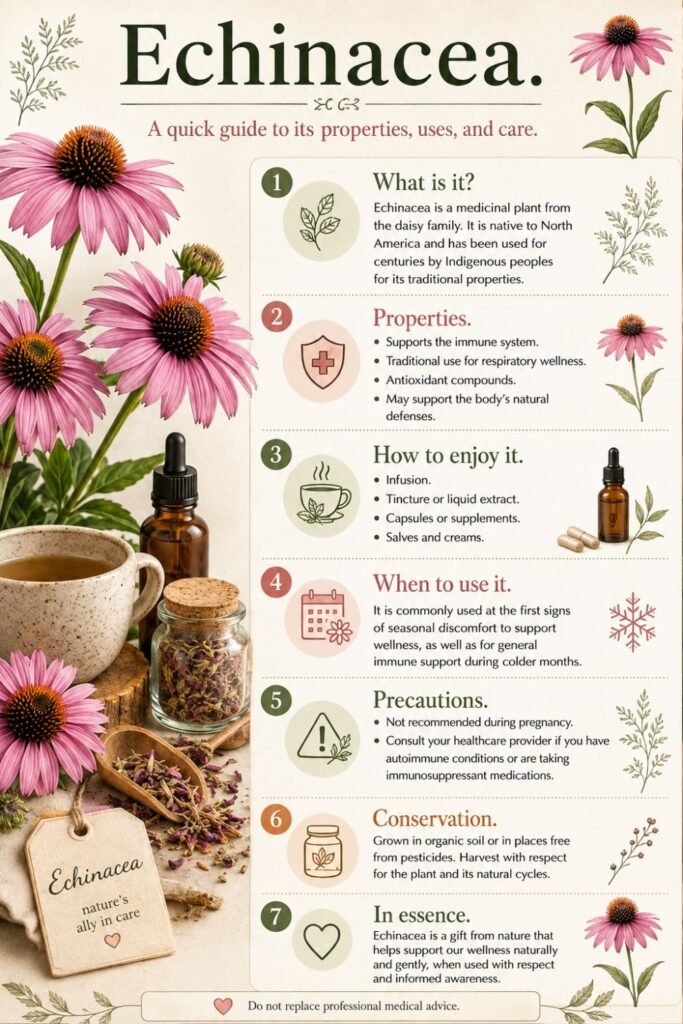
Echinacea is an herbaceous plant in the Asteraceae family. That botanical family is enormous and includes familiar plants like chamomile, calendula, dandelion, daisies and chrysanthemums. That family connection matters beyond trivia, because people who are sensitive to Asteraceae can react to echinacea too.
The best known species in herbal use are Echinacea purpurea, Echinacea angustifolia and Echinacea pallida. The most common in commercial preparations is Echinacea purpurea, though each species has its own characteristics and not all products are alike. That difference matters a lot, because we talk about “echinacea” as if it were one single thing when there can be significant variation depending on the species, the part of the plant used, the extraction method and the concentration.
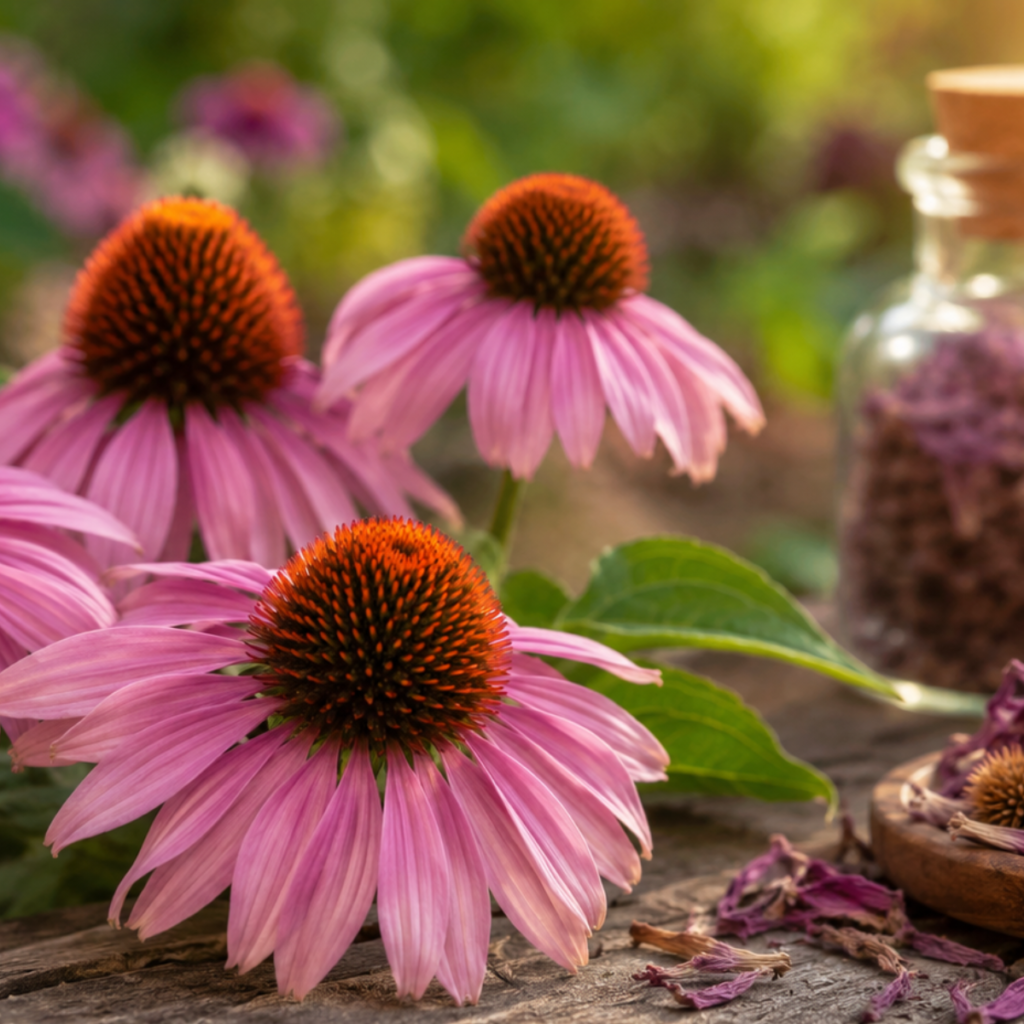
Visually, echinacea is gorgeous. The flowers usually have pink, purple or violet petals with a prominent cone shaped center, which gives them that recognizable look, as if the flower were wearing a small dark crown. It’s beautiful in natural gardens, it attracts pollinators, and it has a wild quality that doesn’t need to be perfect to be irresistible.
People talk about it so much because it’s traditionally been used to support the immune system and help the body through common colds. Many people take it when they notice the first signs of one: the odd throat, the sneezing, the strange tiredness, that “I think I’m coming down with something” feeling. It also shows up in winter formulas alongside vitamin C, zinc, propolis, elderberry, thyme or honey.
It’s worth remembering that echinacea isn’t an invisible shield that stops you getting sick, and it isn’t an instant cure. Its role makes more sense as occasional support. It can be part of a natural care routine, but it doesn’t replace rest, hydration, eating properly, sleep, or medical attention when symptoms are severe or drag on.
A little history
Echinacea is native to North America, where various Indigenous communities used it traditionally for different purposes. Over time its use reached Western herbal medicine and grew in popularity, especially between the late nineteenth and early twentieth centuries. Then, as with many medicinal plants, it went through periods of greater and lesser fame before coming back strongly thanks to the growing interest in natural remedies and herbal medicine.
What’s interesting about echinacea is that it isn’t a trend invented yesterday. It has a long history in traditional use, though that doesn’t mean we should accept everything uncritically. Tradition brings experience, and caution brings balance. A plant can have history and still need to be used responsibly.
Today you’ll find echinacea in countless formats. There are teas, capsules, tablets, liquid extracts, tinctures, syrups, throat sprays, lozenges, combination formulas and even creams and cosmetic products. That variety is convenient, but it can also be confusing.
A mild tea made from dried plant isn’t the same as a concentrated root extract. A product with Echinacea purpurea isn’t the same as one with Echinacea angustifolia, and a simple formula isn’t the same as a blend with ten added ingredients.
So when someone says echinacea “really works for them” or “did nothing at all,” I always think it’s worth asking which product they took, when, for how long, at what dose and in what context. Sometimes the issue isn’t the plant, it’s the expectation, the quality of the preparation, or the timing.
Which parts of the plant are used
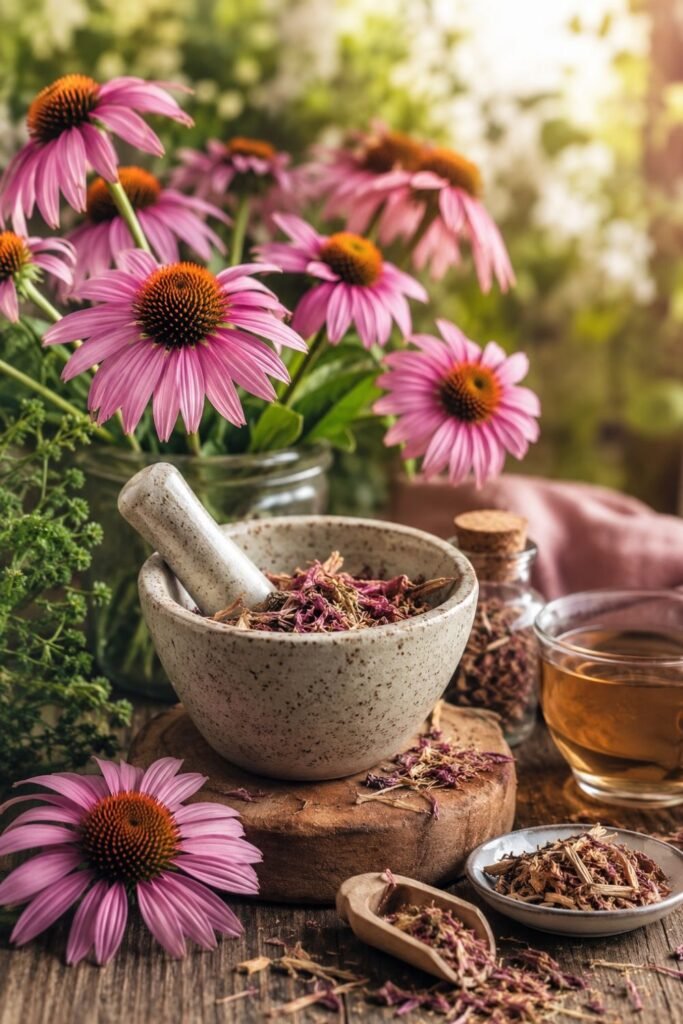
Different parts of echinacea can be used. The most common are the root and the aerial parts, meaning stems, leaves and flowers. Depending on the preparation, you might find fresh plant, dried plant, pressed juice, hydroalcoholic extract, dry extract or tincture. Each form has its own characteristics and its own storage needs.
Echinacea root
Echinacea root has been used extensively in herbal medicine, especially in extracts and tinctures. It’s considered interesting because it concentrates certain plant compounds. In some preparations, the root leaves a very particular sensation in the mouth, a slight tingling or mild prickling. Not everyone notices it the same way, but it’s fairly characteristic of some liquid extracts.
Root isn’t usually the go-to for a simple homemade tea, though you can find it dried and chopped. Either way, when root is involved, preparation and dose matter. It isn’t a part of the plant to handle by eye without knowing what you’re doing.
The aerial parts
The aerial parts include flowers, leaves and stems. They’re very common in Echinacea purpurea preparations and also turn up in teas and extracts. When people talk about dried plant for tea, they’re usually talking about this part. The flavor tends to be herbal, a little earthy and mildly bitter.
This part is particularly interesting because it’s more accessible for home use. Even so, always follow the manufacturer’s directions. A herbal tea still has doses, steeping times and usage recommendations. Coming in a teabag doesn’t mean you can drink it without limits.
Fresh versus dried echinacea
Fresh echinacea is used in some extracts and pressed juices. It has the advantage of preserving certain nuances of the freshly harvested plant, though it’s more delicate and less practical to keep at home. Dried echinacea, on the other hand, is easier to store, more convenient for tea and more common in herb shops.
Don’t assume one is always better than the other. It depends on your goal, the product, the quality and how you’re using it. For a simple home routine, dried plant may be plenty. For something more concentrated, many people prefer well formulated commercial extracts.
The properties of echinacea
When we think of echinacea we almost always think of immunity. That’s natural, since it’s the best known use. Still, the plant has more nuance, and it’s worth talking about its properties calmly, without turning it into an impossible promise.
Echinacea as immune support
Echinacea’s best known property is its traditional use as immune support. That doesn’t mean it “boosts your immune system” automatically, as if the body had a switch. The immune system is a complex network that needs balance, not simply intensity.
I prefer to say echinacea may help the body’s natural response at specific moments. When a cold is starting, when there are sharp temperature changes, or when you feel more run down. That help can be useful for some people, as long as it’s used for a short period and appropriately.
The idea shouldn’t be taking echinacea year round as a guarantee of health. Immune health also depends on sleeping well, eating enough, moving, getting natural light, managing stress, keeping an eye on vitamin D when relevant, and avoiding habits that wear the body down. A plant can add something, but it can’t do everything.
Echinacea at the first signs of a cold
This is probably the most common use. Many people reach for echinacea when they notice the first warnings of a cold. That slightly scratchy throat, the odd tiredness, sudden sneezing or that internal chill are usually the signals that tell us something’s starting.
At that point, echinacea makes more sense than once the cold is fully underway. Most commercial products also recommend starting at the first symptoms and continuing for a few days, always respecting the stated dose.
The important thing is not to leave everything to the plant. If a high fever appears, or difficulty breathing, severe pain, clear worsening or symptoms lasting longer than expected, it’s time to see a doctor. Natural self care is lovely, but so is caution.
Antioxidant properties
Echinacea contains various plant compounds, among them caffeic acid derivatives, flavonoids, polysaccharides and alkylamides. Some of these are associated with antioxidant activity, meaning they may play a role in protecting against oxidative stress, though it’s worth not overstating this.
The word antioxidant gets used a lot these days, sometimes as if it were shorthand for eternal youth or perfect health. It doesn’t work that way. A plant containing antioxidant compounds doesn’t mean taking it will transform your body overnight. It means it belongs to that group of plants that are interesting for their phytochemical richness.
When echinacea fits into a life with good habits, it can be one more ally. When it’s used to make up for lack of rest, constant stress or a poor diet, you’re asking far too much of it.
Anti-inflammatory properties
Echinacea has also been studied for a possible relationship with inflammatory processes. Some of its compounds may influence certain responses in the body. Even so, using the word “anti-inflammatory” requires care, because it doesn’t mean it treats any inflammation or replaces prescribed medication.
In everyday life this property is usually mentioned within its role as a supportive plant for mild winter complaints. It also appears in skin care products, particularly in specific preparations. The key is using products made for each purpose and not improvising homemade applications on sensitive areas or wounds.
Traditional use on the skin
Some external Echinacea purpurea preparations have traditionally been used on small superficial wounds. That doesn’t mean any echinacea product can go on the skin. An alcohol tincture, an opened capsule or a very concentrated tea aren’t necessarily appropriate for a wound.
For skin, use preparations designed for external use. And watch how things develop. If a wound gets very red, feels hot, oozes, hurts, swells or doesn’t improve, see a doctor. Plants can help, but an infection needs professional assessment.
What echinacea is used for day to day
Echinacea tends to be used at fairly specific moments. It isn’t a plant I’d use for everything or take every day without reason. It makes more sense to save it for the situations where it actually fits.
Echinacea when a cold starts
The most common use is taking echinacea when cold symptoms begin. At that point many people take it for a few days, following the product’s directions. The idea is to support the body early, while we’re still in that warning phase.
It can also be paired with very simple care. Resting more, drinking fluids, eating warm food, slowing down and sleeping as well as possible are the basics. Sometimes we want a shiny supplement that fixes everything, but the body usually asks for fairly simple things.
Echinacea in cold weather and seasonal changes
Seasonal transitions tend to be when people feel more vulnerable. Getting back into a routine, spending time indoors, temperature swings and accumulated tiredness can all make colds more likely.
At these times some people use echinacea occasionally. Don’t confuse that with taking it permanently for months. If you want to use it as seasonal support, check the recommended duration on the product or ask a professional.
Echinacea in a herbal medicine cabinet
Echinacea can be part of a natural medicine cabinet alongside other simple plants. Chamomile for light digestion, thyme for winter teas, calendula for external care, lavender for tense moments and echinacea for those first cold warnings makes for a practical combination.
Having a herbal cabinet doesn’t mean self medicating without thinking. It means knowing your plants, reading labels, respecting doses, storing products properly and knowing when not to use them. That detail is the whole difference between responsible use and impulsive use.
How to take echinacea
Echinacea can be taken in several forms. Which one you choose depends on what you’re after, your preferences, your tolerance and what product you have. There’s no single perfect form for everyone.
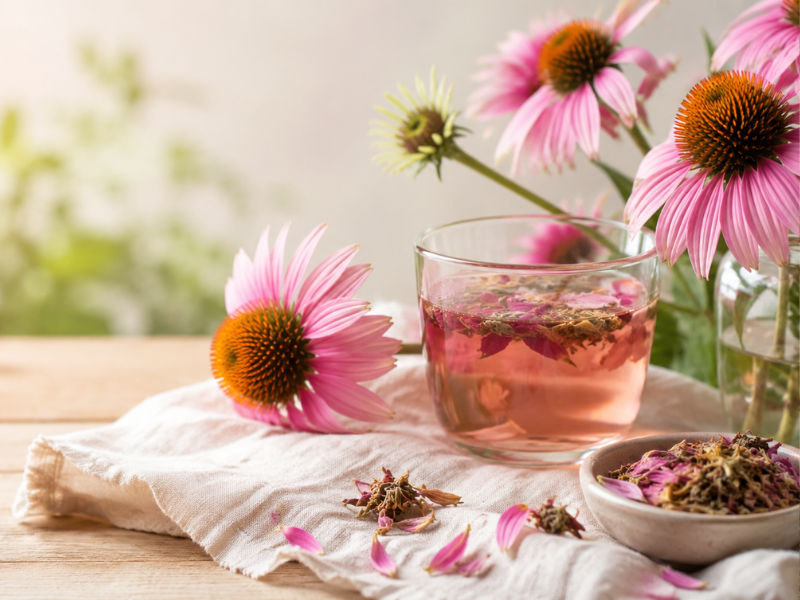
Echinacea as tea
Echinacea tea is one of the simplest, homiest options. It has the advantage of inviting you to stop, make a hot cup and give your body a few minutes. It usually isn’t the most concentrated form, but it can be pleasant and plenty for anyone looking for gentle support.
To make it, follow the directions on the package. Typically you add the dried plant to hot water, cover the cup while it steeps and then strain. Covering it helps preserve the aroma and certain volatile compounds. You can drink it plain or combine it with plants like thyme, elderberry, mallow or ginger, as long as they agree with you.
Echinacea tastes herbal, somewhat earthy and slightly bitter. If that’s too much, you can soften it with lemon or a teaspoon of honey once the tea has cooled a little. Don’t add honey to boiling water, since it loses some of its qualities and the flavor changes. And remember honey isn’t suitable for babies under one year old.
Liquid extract or tincture
Liquid extracts and tinctures tend to be more concentrated than teas. They’re taken as drops diluted in water, usually several times a day depending on the manufacturer. They’re convenient because dosing is quick, though the taste can be strong.
Some tinctures contain alcohol. That matters for anyone avoiding it, for children, during pregnancy or breastfeeding, for people with liver problems, and for anyone on certain medications. In those cases, check before using this format or choose alcohol free alternatives if they’re available and appropriate.
Capsules and tablets
Capsules and tablets are very practical. They let you know the amount per dose and suit anyone who doesn’t enjoy the herbal taste. They’re also easy to carry in a bag or keep at home without fuss.
The important thing is reading the label carefully. Look at the echinacea species, the part of the plant used, the amount per capsule, the type of extract and any added ingredients. Sometimes a product looks simple but contains fillers, blends or unclear doses. It’s also worth remembering that supplements aren’t reviewed for effectiveness before they go on sale, so third party testing and a transparent label matter more here than usual.
Syrups
Echinacea syrups are common in winter products. They often come combined with honey, propolis, vitamin C, zinc, elderberry or other plants. They can be pleasant, especially when your throat is sore, but check the composition carefully.
Some syrups contain a lot of sugar or sweeteners. Others contain propolis, which can cause allergic reactions in some people. There may also be essential oils or other ingredients that aren’t appropriate for young children, pregnancy, breastfeeding or certain conditions. So even though it looks like a gentle product, it’s worth reading properly.
Sprays and lozenges
Echinacea sprays and lozenges are usually aimed at throat care. They can be handy for dryness, mild irritation or a scratchy throat. They’re often combined with propolis, honey, sage, thyme or mint.
Don’t confuse local relief with treating a serious infection. If the sore throat is severe, or there’s fever, white patches, difficulty swallowing or worsening symptoms, see a doctor. A spray can soothe, but it shouldn’t mask important signs.
Combination products
Combination products can be useful, but they aren’t always better. A formula with many ingredients can look more powerful while actually being harder to evaluate. If something disagrees with you, you won’t know whether it was the echinacea, the propolis, the zinc, the sweetener, an essential oil or something else.
For sensitive people, or anyone with allergies or on medication, simpler formulas are usually preferable. Fewer ingredients doesn’t mean less care. Often it means more clarity.
When to take echinacea
Timing matters. Echinacea usually makes the most sense when the first cold symptoms appear. That start can feel like unusual tiredness, a dry throat, sneezing, an internal chill or a heavy body.
Taking it early doesn’t guarantee the cold will disappear, but it fits better with its traditional use. If you wait until you’ve had strong symptoms for several days, the effect may be less noticeable or simply absent.
Some people also take it during specific periods of greater exposure. At the start of fall, during temperature swings, or when living with someone who has a cold. In those cases, the important thing is not to extend use unnecessarily. Echinacea is generally recommended for short periods, not as a permanent routine without supervision.
How long you can take it
Duration depends on the product and the situation. Many preparations are used for just a few days, especially at the onset of cold symptoms. Some recommendations mention a week or ten days, though the product label or professional advice should always be the guide.
If symptoms persist, worsen or become more intense, don’t keep taking echinacea and hope it resolves on its own. A common cold usually improves over a few days, but not everything that looks like a cold is one. High fever, difficulty breathing, chest pain, extreme exhaustion or symptoms lasting too long deserve to be looked at.
What the science says
The science on echinacea doesn’t give an answer as simple as “it works” or “it doesn’t.” There are studies suggesting possible benefits from specific preparations, especially taken at the start of a cold. There are also studies that find no clear effect. That mix of results comes down to several things.
One of the main reasons is that not all echinacea products are the same. The species varies, as do the plant part, the extraction method, the dose, the concentration and the quality. So does the moment a person starts taking it. Taking a well formulated extract on day one of symptoms isn’t the same as an occasional cup of tea when you’ve already had a cold for a week.
The most sensible conclusion is that echinacea may be useful for some people in some contexts, but it shouldn’t be presented as a guaranteed solution. When there is an effect, it tends to be modest. Even so, herbal medicine isn’t always about a dramatic result. Sometimes it’s about supporting mild processes, feeling cared for, and adding something that fits into a healthy routine.
The main compounds in echinacea
Echinacea contains a mix of plant compounds that explain part of the interest in it. Among them are alkylamides, polysaccharides, glycoproteins, flavonoids and caffeic acid derivatives such as cichoric acid in some species.
These compounds can vary a lot depending on the species and the plant part. The root doesn’t have exactly the same composition as the flower or the leaves. A plant grown in one set of conditions isn’t the same as one grown in another, and a hydroalcoholic extract isn’t the same as a water infusion.
With medicinal plants, the whole is usually what matters. It isn’t always about isolating one molecule and crediting it with everything. Often the interest lies in the natural combination of substances. That complexity is part of what makes herbal medicine fascinating, and also what obliges us to be careful when talking about results.
The benefits of echinacea
It may support your immune response
Echinacea is traditionally used as immune support. That doesn’t mean it makes the body invincible or prevents every cold. It means it can be part of a care strategy when your system needs a little extra support.
It may be useful at the start of a cold
Many people take it when the first symptoms appear. That’s usually the most common moment to use it. The key is not expecting miracles, respecting the dose, and pairing it with rest, hydration and calm.
It fits into a natural winter routine
Echinacea sits well in a winter routine alongside hot teas, comforting food, enough sleep and staying warm. It shouldn’t take the place of the basics, it should be added to them.
It appears in some skin preparations
Certain external products with echinacea have traditionally been used on small superficial wounds. Even so, use products designed for skin rather than improvising with whatever format you have.
It’s easy to find
Echinacea is available at pharmacies, health food stores and specialty shops. That availability is convenient, but it also calls for judgment. The label, the quality and the brand matter.
Important precautions before taking echinacea
Echinacea can be an interesting plant, but it isn’t right for everyone. Before taking it, it’s worth going through a few precautions.
Allergies to the daisy family
Since echinacea belongs to the Asteraceae family, anyone allergic to plants like daisies, ragweed, chrysanthemum or calendula should be especially careful. An allergic reaction can be mild, but it can also be serious.
If taking echinacea brings on intense itching, hives, swelling, difficulty breathing or feeling seriously unwell, stop taking it and get medical help. Trouble breathing or swelling of the face or throat is an emergency, so call 911 rather than waiting it out.
Autoimmune conditions
People with autoimmune conditions should check with a doctor before taking echinacea. In these conditions the immune system is already behaving abnormally, so adding plants associated with immune response without supervision isn’t a good idea.
This can include lupus, rheumatoid arthritis, multiple sclerosis, inflammatory bowel disease and other autoimmune conditions. It doesn’t mean it’s always off limits, but it isn’t a decision to make lightly.
Immunosuppressant treatment
Anyone taking immunosuppressant medication, for example after a transplant or for an autoimmune condition, should avoid echinacea unless a professional says otherwise. The reason is simple: we don’t want to interfere with treatments that regulate immune activity.
Pregnancy and breastfeeding
Pregnancy and breastfeeding aren’t the time to improvise with medicinal plants. Even though echinacea may seem gentle, these stages call for real caution. Check with your midwife, doctor or pharmacist first.
Children
Extra care is needed with children. Not all echinacea products are appropriate for every age. Some contain alcohol, honey, propolis, sweeteners, essential oils or other ingredients that may not be suitable.
A child’s dose shouldn’t be estimated by scaling down an adult dose. Use products specifically labeled for children and check with your pediatrician or pharmacist.
Regular medication
If you take medication regularly, check before adding echinacea. Some plants interact with medications and echinacea is no exception. Caution matters especially with immunosuppressants, complex liver treatments, drugs with a narrow safety margin, or several medications at once.
Possible side effects
Echinacea is generally well tolerated by healthy adults using it short term, but it can cause side effects. The most common are digestive discomfort, nausea, stomach pain, diarrhea, an unpleasant taste or that tingling sensation with some liquid extracts.
Skin reactions like itching, redness or rashes can also appear. In sensitive or allergic people, reactions can be more severe. That’s why it’s important to watch how your body responds, especially the first time you take it.
If a plant disagrees with you, there’s no need to push through it. We sometimes insist because something has a good reputation, but every body responds in its own way. Listening to that response is part of taking care of yourself.
Echinacea and colds, with common sense
When the first cold symptoms show up, echinacea can be worth considering. Still, I think it’s important to look at the whole picture. Often the body isn’t just asking for a plant, it’s asking for rest.
If you’ve been sleeping badly for days, eating whatever, stressed and never stopping, the cold probably didn’t come out of nowhere. The body gives warnings. At that point a cup of echinacea tea can help, but so can slowing down, hydrating, eating something warm, sleeping more and not carrying on as if nothing were happening.
Echinacea fits best as part of broader care. Taking it while still pushing your body, sleeping four hours and living in a rush probably isn’t the best strategy. Natural care starts with the basics.
How to choose a good echinacea product
Choosing well matters. The market is full of products and they aren’t all the same quality. A good choice starts with reading the label carefully.
Check the species
Ideally the product states which species it uses. It might be Echinacea purpurea, Echinacea angustifolia or Echinacea pallida. If it just says “echinacea” with no further information, it’s less clear what you’re taking.
Look at which part of the plant is used
It helps to know whether the product contains root, aerial parts, whole plant, fresh plant juice or dry extract. This information helps you understand the preparation and shows transparency on the brand’s part.
Check the concentration
With capsules, tablets and extracts, it’s useful to check the amount per dose. Some products state the equivalent in dried or fresh plant. Others explain the extraction ratio. These details may seem technical, but they help distinguish serious products from vague labels.
Review the added ingredients
Many echinacea products include other ingredients. There may be vitamin C, zinc, propolis, elderberry, honey, essential oils, sugar, sweeteners or preservatives. There’s nothing wrong with combination formulas if they suit you, but you need to know what’s in them.
Choose brands you trust
The most expensive isn’t always the best, but exaggerated promises are usually a bad sign. If a product claims to cure everything, prevent every virus or transform your health in two days, be skeptical. A serious brand tends to be clear, cautious and specific.
How to store echinacea properly
Storage is essential for keeping echinacea’s quality. A badly stored plant can lose aroma, color and potency. And if moisture gets in, it can spoil.
Storing dried echinacea
Dried echinacea should be kept in a clean, dry, tightly closed jar. Ideally somewhere cool, out of direct light and away from humidity. The bathroom and kitchen aren’t always the best spots, since there’s steam and temperature changes.
It’s also worth labeling the jar with the plant name and the purchase date. It seems like a small detail, but it helps a lot. Dried plants don’t last forever. Over time they lose aroma and quality, even when they don’t visibly spoil.
If you open the jar and notice an odd smell, moisture, mold, strange discoloration or a clumped texture, throw it out. A medicinal plant needs to be in good condition to be used safely.
Storing tinctures and liquid extracts
Tinctures and liquid extracts should be kept in their original container, tightly closed and protected from light. Many come in dark glass bottles precisely to protect the contents. Don’t touch the dropper with your mouth or hands, since that can contaminate the product.
Respect the expiration date too. If the extract changes noticeably in smell, color or texture, ask about it or throw it out. Some products have specific storage instructions, so the label always wins.
Storing capsules and tablets
Capsules and tablets should stay in their original packaging. Moving them into unlabeled jars is a bad idea, because you lose important information like dose, batch, expiration date and ingredients. They should also be kept away from heat, humidity and out of reach of children.
Storing echinacea syrups
Syrups can be more delicate. Some need refrigeration once opened and others don’t. Always read the instructions on the package. If a syrup smells fermented, changes texture, produces gas or looks strange, don’t take it.
How to grow echinacea at home
Growing echinacea can be a lovely experience if you have a garden, a patio or a spot with good light. It’s a beautiful ornamental plant, hardy and attractive to bees, butterflies and other pollinators.
Light
Echinacea generally prefers full sun or plenty of light. In very hot regions it may appreciate some protection during the most intense hours, but in general it’s a sun lover. With too little light it grows weaker and flowers less.
Soil
The soil needs to drain well. Echinacea doesn’t tolerate constant waterlogging. If the soil holds too much water, the roots suffer. In a pot, use a light potting mix and make sure the container has drainage holes.
Watering
During the first few weeks it needs regular watering to get established. After that, once settled, it tolerates some drought. Water deeply and let the soil dry out a bit before watering again, rather than keeping it constantly damp.
Flowering
Echinacea usually blooms in summer and stays beautiful for quite a while. The flowers bring color, life and movement to a garden. And if you leave some seed heads standing, they feed birds and give the space a lovely natural look.
Harvesting at home
If you want to harvest echinacea for your own use, do your research first. You need to know which species you have, which part you want to use, when to harvest and how to dry it. It’s also essential not to consume plants treated with pesticides, ornamental fertilizers not intended for edible plants, or garden chemicals.
Common mistakes when using echinacea
One of the most common mistakes is taking echinacea for months without needing to. Because it has a reputation for supporting immunity, some people use it continuously all winter. That doesn’t always make sense. Most traditional uses are framed as short term and situational.
Another frequent mistake is assuming more will work better. With medicinal plants, more doesn’t mean better. It can mean digestive discomfort, more risk of interactions, or simply wasted product.
Using it as a substitute for medical care is also a mistake. If there’s high fever, difficulty breathing, severe pain, persistent symptoms or clear worsening, this isn’t the moment to keep trying home remedies. Echinacea can help with mild processes, but it shouldn’t delay a necessary appointment.
Buying any product without reading the label is very common too. Not all preparations are the same. The species, the part used, the dose and the added ingredients all matter.
Mixing too many supplements at once is another classic. Sometimes, in an effort to take really good care of ourselves, we end up taking an enormous combination of plants, vitamins, minerals and syrups. The body may not appreciate all that enthusiasm. Simplicity is usually safer and easier to evaluate.
Frequently asked questions about echinacea
What is echinacea?
Echinacea is a medicinal plant in the Asteraceae family. The most commonly used species are Echinacea purpurea, Echinacea angustifolia and Echinacea pallida. It’s traditionally used to support the body during cold season and as occasional immune support.
What is echinacea used for?
Echinacea is used mainly as support at the first signs of a cold and during cold weather. It also appears in some external preparations for the care of small superficial wounds. It shouldn’t be treated as a miracle cure or as a replacement for medical care when that’s needed.
Does echinacea cure colds?
No. Echinacea doesn’t magically cure a cold. It may help some people as occasional support, especially taken at the onset of symptoms, but it doesn’t guarantee the cold will go away or that you won’t get sick.
When is the best time to take echinacea?
It usually makes the most sense when the first cold symptoms appear, like an odd throat, sneezing, tiredness or a heavy feeling in the body. It can also be used during specific periods of greater exposure, always respecting the recommended dose and duration.
How long can I take echinacea?
It depends on the product, but it’s normally used for short periods. Many recommendations fall somewhere between several days and about a week, though you should always follow the label. If symptoms persist or worsen, see a doctor.
Can I take echinacea every day?
Taking echinacea every day for long stretches isn’t advisable without professional advice. Its use is usually occasional. For daily immune care, focus on sleeping well, eating nourishing food, moving, staying hydrated and reducing stress.
Does echinacea have side effects?
Yes, it can. Some people experience digestive discomfort, nausea, diarrhea, an odd taste, tingling in the mouth or skin reactions. Anyone allergic to plants in the daisy family should be especially careful.
Can echinacea cause an allergic reaction?
Yes, particularly in people sensitive to plants like daisies, ragweed, chrysanthemums or calendula. If hives, swelling, difficulty breathing or a severe reaction appear, seek medical attention right away.
Can I take echinacea if I have an autoimmune condition?
Not without checking first. Because echinacea is associated with immune response, people with autoimmune conditions need professional guidance before using it.
Is echinacea better in capsules or as tea?
It depends what you’re after. Tea is gentler and has a lovely ritual quality. Capsules and extracts tend to be more concentrated and easier to dose. What matters is choosing a quality product and using it correctly.
Echinacea strikes me as a beautiful, useful and genuinely interesting plant to keep in mind when the cold arrives. I love it because it brings together tradition, beauty and practicality.
Its place is in conscious self care. It can be part of a winter routine, of a simple herbal cabinet, or of those small gestures we make when we feel our body starting to ask for attention. A hot cup of tea, a well chosen extract, a longer rest and a quiet afternoon can add up to something far more powerful than they look.
I also think echinacea reminds us of something important: taking care of yourself doesn’t have to be complicated. Sometimes it’s about listening before you hit your limit, choosing quality products, respecting doses, not mixing things for the sake of it, and knowing when to ask for help.
If you’ve already tried echinacea, I’d love to hear from you in the comments. Tell me whether you prefer it as tea, capsules, extract or syrup, or whether you have it growing at home. You can also share how you use it in winter, which combinations you like, or what questions you have. Your experience is sure to help someone who’s just discovering this lovely plant.