Explore the fascinating world of cosmetic waxes in this complete guide. Learn to tell plant, animal and synthetic waxes apart, what each one brings to the skin, and how to store them properly for your natural skincare recipes.
If you love making your own concoctions, or you just want to understand what on earth those ingredients on your favorite cream labels actually are, you’re going to love what I have for you today. We’re talking about waxes. Yes, those substances that sometimes go unnoticed but that are the backbone of so many products we use every day.
You’ve caught me in a burst of energy. Lately I can’t stop experimenting in my workshop, and I’ve realized that even though all waxes look alike at first glance, each one has a personality of its own. Using beeswax is nothing like using candelilla or rice wax. The texture changes, the feel on skin changes and, of course, the final result of your formula changes. So get comfortable, grab something nice to drink, and let’s dive deep into this waxy universe.
This post contains affiliate links, at no cost to you
Why waxes are your skin’s best friend
First, let’s be clear about what a wax actually is. We could get very technical about the chemistry, but as I said, here we talk like friends. Think of waxes as a protective barrier. In nature, plants use them to avoid drying out and to protect themselves from insects and harsh sun. When we use them in skincare, they do something very similar for us.
They’re structuring agents. Without them, your lip balms would be a puddle of oil and your richer body creams wouldn’t have that satisfying body to them. But they aren’t just for hardening. Waxes are emollient, meaning they soften the skin and help slow water loss. They act like an invisible shield that reduces evaporation without completely sealing the skin off.
Waxes also work as co-emulsifiers, adding body and stability to a mix of oils and water based ingredients. That said, a wax on its own doesn’t emulsify anything. If your cream separates, what’s usually missing is a real emulsifier, with the wax playing a supporting role.
| Type of wax | Origin | Texture / form | Melting point | Main characteristics | Common uses in DIY skincare |
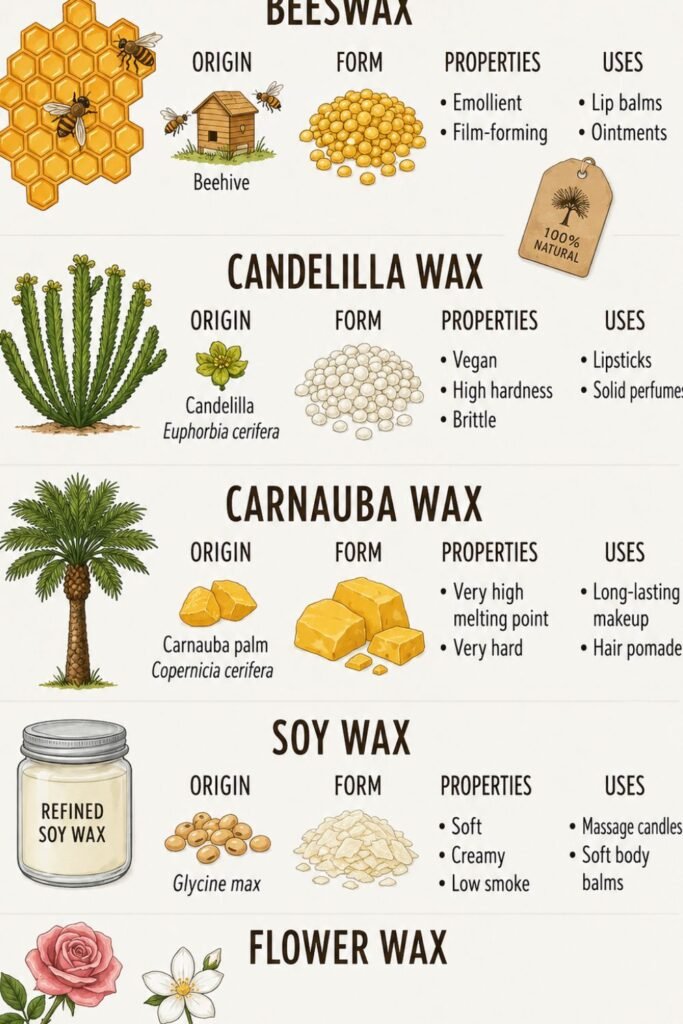
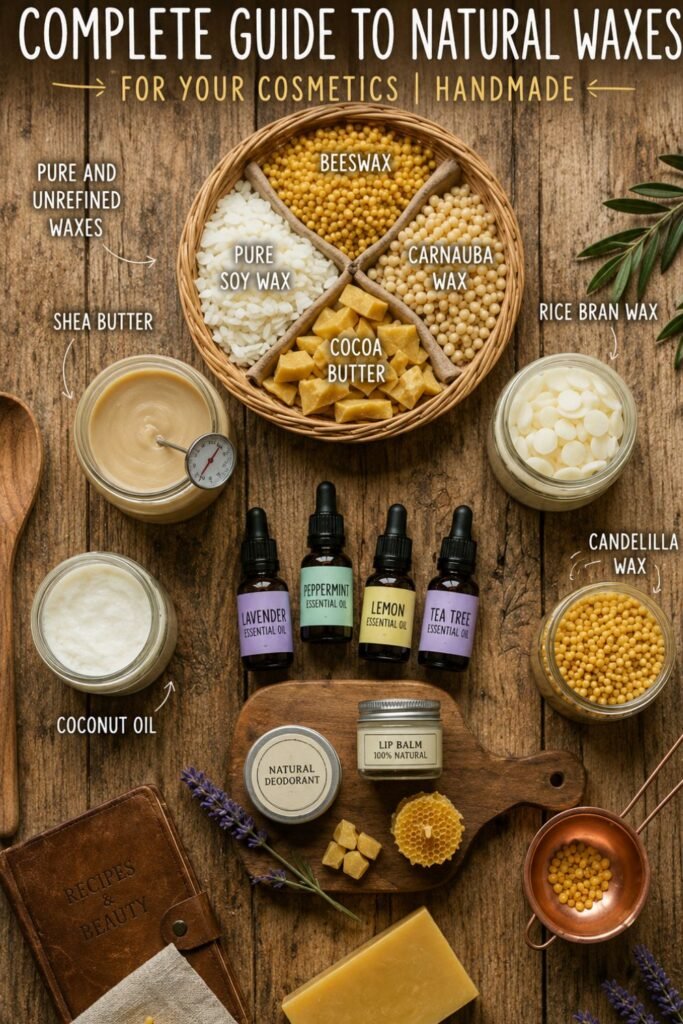
| Beeswax (Cera Alba / Flava) | Animal (honeycomb) | Pastilles, sheets or blocks. Yellow (natural) or white (refined). | 144°F – 149°F (62°C – 65°C) | The most common one. Firm, film forming, emollient and structuring. The yellow kind has a distinct honey scent. | Lip balms, ointments, creams (as a co-emulsifier), massage bars, massage candles. |
| Candelilla wax (Euphorbia Cerifera) | Plant (candelilla shrub) | Small pale yellow flakes or pastilles. | 154°F – 162°F (68°C – 72°C) | The vegan alternative to beeswax. Harder and more brittle. Adds shine and molds beautifully. | Lipsticks, mascara, balms, makeup sticks. |
| Carnauba wax (Copernicia Cerifera) | Plant (leaves of the carnauba palm) | Hard yellow-brown flakes. | 180°F – 187°F (82°C – 86°C) | The hardest of the plant waxes. Very high melting point. Adds intense shine and durability. | Long wearing lipsticks, mascara, hair pomades, depilatory waxes. |
| Soy wax (Hydrogenated Soybean Oil) | Plant (hydrogenated soybean oil) | White or cream colored flakes. | 113°F – 131°F (45°C – 55°C, varies by type) | Very soft, creamy texture. Low melting point. Not for hardness, but great for soft textures. | Massage candles (very popular), body moisturizers, soft body balms. |
| Rice wax (Oryza Sativa Bran Wax) | Plant (rice bran) | Fine powder or small off-white flakes. | 171°F – 180°F (77°C – 82°C) | Fine, non greasy texture. Gives a matte, silky finish. A good emulsion stabilizer. | Mattifying facial creams, lotions, body powders, makeup. |
| Lanette O (Cetearyl Alcohol) | Synthetic / plant (derived from vegetable oils) | White flakes or pellets. | ~122°F (~50°C) | Not a wax in the strict sense (it’s a fatty alcohol), but it works as a co-emulsifier and thickener in emulsions. | Creams, lotions, hair conditioners. |
Classifying waxes by origin: where they come from and what that tells us
Not all waxes are created equal. Depending on where they’re sourced, they’ll have different characteristics. Broadly, we split them into three groups: animal, plant, and mineral or synthetic.
The queen of animal waxes: beeswax
This is probably the best known wax in the world. It’s been used since antiquity in cosmetic preparations and traditional remedies. Young bees produce it from glands in their abdomen and use it to build the combs where they store honey and raise their larvae. It’s a marvel of natural engineering.
In skincare, beeswax is valued above all for the protective film it forms on the skin. It’s traditionally been credited with mild soothing and antiseptic effects, though what you’ll actually notice in a homemade product is that protection against cold and friction. If your skin is very dry or chapped, it’s a great ally. Of course, if you live a vegan lifestyle it isn’t for you, and anyone with an allergy to hive products should test it on a small patch first.
You’ll see two main types in stores: yellow beeswax and white. The yellow is virgin wax, straight from the comb after filtering. It has a lovely honey aroma and retains more of the hive’s own components. The white kind has been bleached, sometimes naturally by sun exposure and sometimes through chemical processes. It’s used when you want a colorless final product, or when you don’t want the scent competing with a fragrance you plan to add.
The fascinating world of plant waxes
This is where things get exciting for those of us looking for cruelty free options, or who simply want to explore different textures. Plant waxes are extracted from the leaves, stems or fruit of certain plants. They’re wonderful options because they tend to be light and come with a wide range of melting points.
The most common ones are candelilla, carnauba, rice, soy and mimosa. Each has a different shine and its own hardness. If you want a mirror finish on a lipstick, carnauba is your best bet. If you want something softer and creamier, soy is ideal.
Mineral and synthetic cosmetic waxes: a brief mention
Even though this post focuses mainly on the natural options because that’s what we love here, it’s worth knowing these exist. This is where paraffins and petroleum derived microcrystalline waxes come in. They’re widely used in conventional cosmetics because they’re inexpensive, very stable and well tolerated. They don’t bring the minor components plant waxes have, they essentially create an occlusive layer, which for certain products (a protective ointment, for instance) is exactly the point. There are also synthetic waxes made in labs to mimic the properties of natural ones with tighter control over purity.
A closer look at the most widely used plant waxes
Let’s get into the details. If you want to start formulating or you’re wondering what to buy, this section is key. I’ve tried plenty of them, and here’s my experience with each.
Candelilla wax: the most versatile vegan alternative
This wax comes from a shrub that grows in Mexico and the southwestern United States called Euphorbia antisyphilitica. It’s fairly hard, though not as hard as carnauba. What I like most about candelilla is how versatile it is.
Its melting point is around 154 to 162°F. That matters, because it means the finished product holds up well in heat without melting easily. It’s excellent for lip balms, since it adds firmness and a pretty natural shine. It also leaves a slightly lighter feel on the skin than beeswax does.
Carnauba wax: the crown jewel of hardness
This one comes from the leaves of a Brazilian palm. It’s known as the queen of waxes because it’s the hardest of plant origin. Its melting point is quite high, around 180 to 187°F.
What do we use it for? Mainly structure and heat resistance. If you’re formulating a lipstick that’s going to live in a purse through a brutal summer, you need carnauba. It’s also common in hair products and mascara because of the glossy film it creates. Just use it in small amounts, because too much makes the product stiff and crumbly.
Rice wax: elegance and softness
This is one of my personal favorites for facial products. It’s obtained from rice bran and has a very fine texture. It isn’t as hard as the others, which makes it ideal for creams where you want a silky, non greasy feel.
Rice wax contains antioxidant compounds naturally present in the bran, like tocopherols and oryzanol. In formulating, it adds real stability and leaves an elegant matte finish, so it works beautifully for combination or oily skin that doesn’t want extra shine but does want a light protective layer.
Soy wax: the queen of massage and comfort
A lot of people associate soy wax only with candle making, but cosmetic grade soy wax is wonderful. It’s a soft wax with a very low melting point, which means it melts almost on contact with skin.
It’s used constantly in massage candles, but also in rich body creams and cuticle balms. It adds a lot of creaminess and spreads with remarkable ease. If you’re just starting to make your own products, it’s very forgiving and hard to get wrong. If you’re using it in massage candles, always test the melted wax on your own wrist before applying it to someone else’s skin.
Floral waxes: a touch of sensory luxury
Here we move into more exclusive territory. There are waxes obtained during the extraction of essential oils from flowers, like rose wax, jasmine or mimosa. These aren’t structural waxes, meaning you won’t use them to keep a lipstick from breaking. They’re used as cosmetic actives and for their scent.
They add a beautiful sensory quality and a lovely feel. Adding a bit of rose wax to a night cream is like handing your face a bouquet of flowers. They’re expensive, but a little goes a long way since you use them at very low percentages. Because they retain some of the flower’s aromatic components, patch test first if your skin is reactive.
Key differences: how to choose the right one for your project
I understand that with so many options you might feel a little lost. Which one do I pick? The answer is always: it depends on what you’re trying to make. Let’s compare the key points so you can decide.
Differences in hardness and consistency
If you’re after a solid stick, like a deodorant or a lipstick, you need hard waxes. The hardness ranking goes: carnauba > candelilla > beeswax > rice > soy.
If a recipe calls for beeswax and you want to swap in a plant wax, you can’t use the same amount. To replace beeswax with candelilla, for example, you’ll usually need considerably less, somewhere around half to two thirds, because candelilla hardens much more. Brands vary, so always make a small test batch before committing to a large one.
Differences in shine and finish
Do you want a glossy or a matte finish? Carnauba gives the most intense shine. Candelilla gives a natural, medium shine. Rice wax and beeswax tend toward matte. This matters a lot if you’re designing a makeup line, for example.
How they feel and absorb
Beeswax and soy wax feel more enveloping on the skin, almost like a hug. They’re ideal for winter. Rice wax and candelilla feel cooler and lighter, which makes them better for summer products or for anyone who hates the sensation of something sitting on their skin.
Beyond texture: what waxes bring to your skin
Waxes aren’t just filler, though it’s worth being clear that their main role is a physical one: they protect, add body and slow water loss.
Beeswax is a terrific barrier against cold, wind and friction. It’s ideal for protective hand balms if you work outdoors, and for shielding chapped areas while skin recovers on its own. That said, a balm isn’t a treatment: for open wounds, burns or anything that isn’t improving, see a pharmacist or a doctor.
Candelilla wax suits skin that doesn’t tolerate heavy textures, since it leaves a lighter feel. It’s often described as having an affinity with skin’s own sebum, though don’t expect it to regulate oil production. What it really delivers is structure and a lighter film.
Rice wax tends to sit well with sensitive skin because it’s so light and never feels greasy. It isn’t a soothing ingredient in the strict sense, but its subtlety makes it comfortable for people who react easily. As always, test a small area first.
How to store your waxes so they last for years
One of the advantages of waxes is how stable they are. Unlike plant oils, which can go rancid fairly easily, waxes last a very long time with minimal care.
Keep them somewhere cool, dry and dark. They don’t need to go in the fridge, and I’d actually advise against it, since they can pick up moisture that causes trouble later when you melt them. A cabinet away from heat sources like the oven or a radiator is perfect.
They usually come as pastilles, flakes or blocks. My advice is to always buy pastilles or flakes. They’re far easier to weigh accurately and they melt faster and more evenly. With a big block you’ll have to grate it, and that’s a chore, take it from me.
Always make sure the container is properly sealed. Even though the wax itself won’t spoil, it can attract dust and lint, and you don’t want to find that in the middle of your beautiful face cream. Kept clean and dry, waxes generally stay in good shape for two or three years. Write the purchase date on the container and check whatever expiration your supplier gives.
Melting waxes: tricks so you don’t lose your mind
Melting wax looks simple, but there’s a knack to it. The most common mistake is heating it over direct heat. Never do that. Wax scorches easily, loses its properties and, worse, can catch fire. Never leave wax on the stove unattended, keep a lid nearby to smother the pot if you need to, and if it ever does ignite, never throw water on it.
A double boiler is your best friend. Put the container of wax inside another with hot water that isn’t at a rolling boil. Be patient. Carnauba, for instance, takes its time to melt and needs a high temperature, so be careful of burns while handling it.
One tip I’ll give you: melt the wax on its own first, or with whichever oil is most heat stable. Once it’s liquid, take it off the heat and add the more delicate oils. That way you avoid overheating the ingredients that are most sensitive.
If you see clumps forming when you mix the melted wax with your oils, the oils were too cold. No problem, put the whole thing back over the double boiler for a moment and stir gently until it’s smooth again.
Practical applications: from theory to your bathroom shelf
What can you do with all this knowledge? Plenty. Here are a few ideas to get you imagining your own creations:
Lip balms: use a mix of candelilla and rice wax for a balm that’s soft but sturdy. Massage bars: soy wax with cocoa butter is heavenly on skin right after a shower. Protective balms: virgin beeswax with calendula oil for dry, beat up areas. Night creams: a touch of rice wax for body with a light texture. Brow wax: carnauba is perfect for keeping every hair in place all day.
One important reminder: any formula containing water (creams, lotions, gels) needs a broad spectrum preservative. Products that are purely oil and wax, like balms, don’t, but they should never get wet or be scooped with damp fingers.
Frequently asked questions about cosmetic waxes
Can I mix different waxes in the same product?
Absolutely, and it’s actually the norm. Blending waxes gets you the best of each. You might use carnauba for structure and rice wax for softness, for example. Start with small batches and write down your ratios so you can repeat whatever works.
Does beeswax clog pores?
This is the big question. At the concentrations typically used in a cream, beeswax usually isn’t a problem and isn’t considered especially comedogenic. That said, if your skin is oily and you use a balm that’s almost entirely wax, you might notice a breakout. For acne prone skin I’d reach for lighter waxes like rice wax, and if the acne is persistent, a dermatologist is the right call.
How can I tell if a wax is good quality?
Look at the smell and the color. A natural wax usually smells faintly of its source (honey for beeswax, a soft herbaceous note for candelilla). If it smells like plastic or harsh chemicals, be suspicious. Also, always buy from suppliers you trust who provide a spec sheet, a batch number and an expiration date.
Are waxes safe for children?
They’re generally well tolerated and widely used in balms made for kids. Even so, children’s skin is thinner, so keep formulas simple, patch test first and skip essential oils. Beeswax calls for a bit more care if there’s any allergy to hive products. For babies, and especially under age one, check with your pediatrician before applying anything.
Why did my lip balm turn out grainy?
This tends to happen with waxes and butters when they cool too slowly and form crystals. To avoid it, pop the filled containers in the fridge for a few minutes after pouring. Cooling quickly helps the texture set smooth.
Final tips for successful formulating
When you get started, remember that less is more. Begin with low percentages of wax. In a cream, 2 to 5% is usually enough to add body. In a lip balm you can go up to 20 or 30% depending on how firm you want it.
Don’t get frustrated if the texture isn’t exactly what you pictured on the first try. Natural formulating is part art, part science. Always write down your recipes and the exact amounts you used. If it came out too hard, take 2% of the wax out next time and add 2% more oil.
Sustainability is another thing worth thinking about. Try to find waxes with clear traceability. Carnauba is fantastic, for example, but make sure it comes from responsibly managed sources. Same with soy, look for non GMO if that matters to you.
My experience with cosmetic waxes
Learning to work with waxes gave me the freedom to stop depending on mass market products. Now I know exactly what’s in my formulas, I choose plant based and biodegradable ingredients, and that gives me real peace of mind.
I hope this guide helped clear things up and left you eager to start experimenting. Waxes are an enormous subject and we’ve only scratched the surface, but you now have a solid base for reading any ingredient label with new eyes.
Has a cream ever felt like it was suffocating your skin? It may have been the type of wax it contained, or simply a texture that was too occlusive for you. Or have you tried making a balm and ended up with something like a rock? Tell me in the comments. I love reading about your experiences and learning together.
Which wax are you dying to try right now? Do you have a secret trick you want to share with everyone? I’ll be waiting down below for a chat!
Thank you for making it this far and for sharing this little moment of natural skincare enthusiasm with me. See you in the next post, full of more ideas and energy for taking care of ourselves the way we deserve. A big hug!