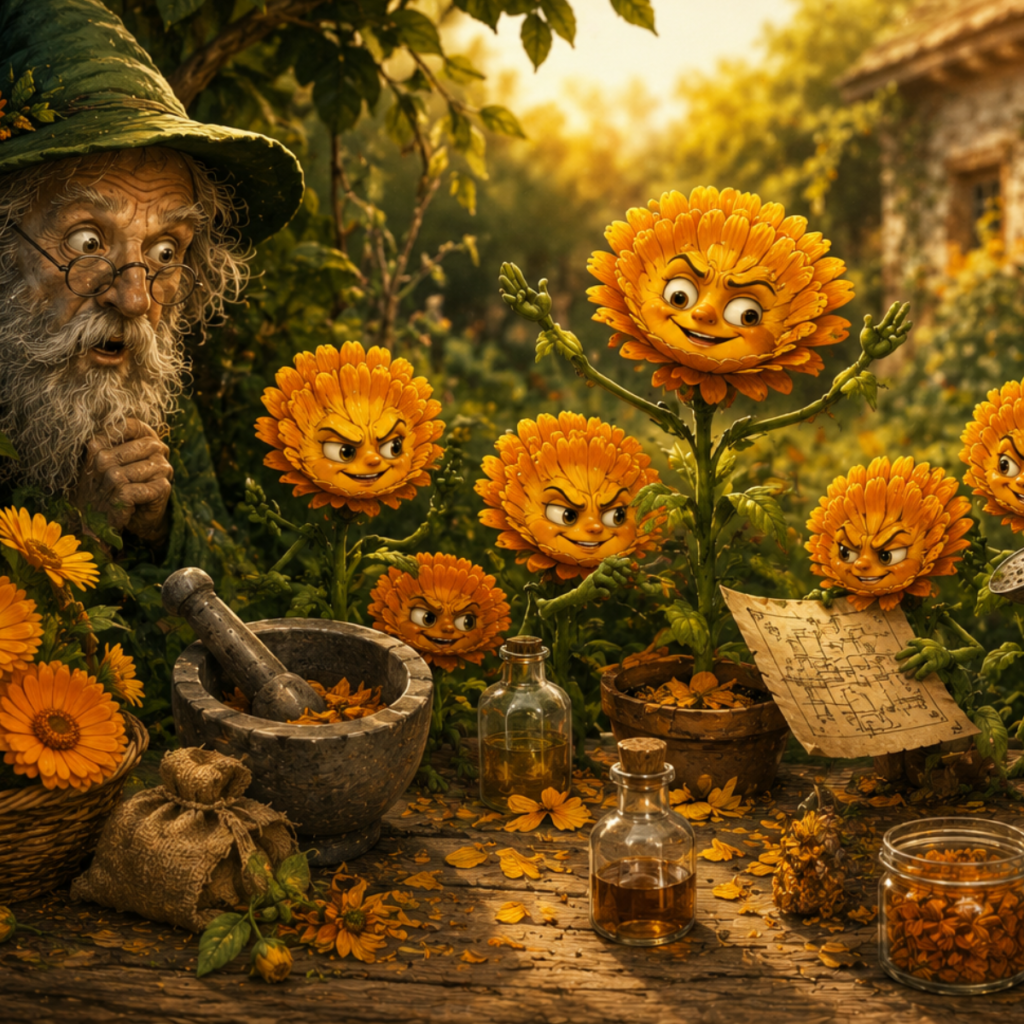
Discover the fun conspiracy of the rebellious marigolds, an herbal chronicle full of botanical humor, mystery, useful flowers, and garden secrets inside The Secret Herbalist.
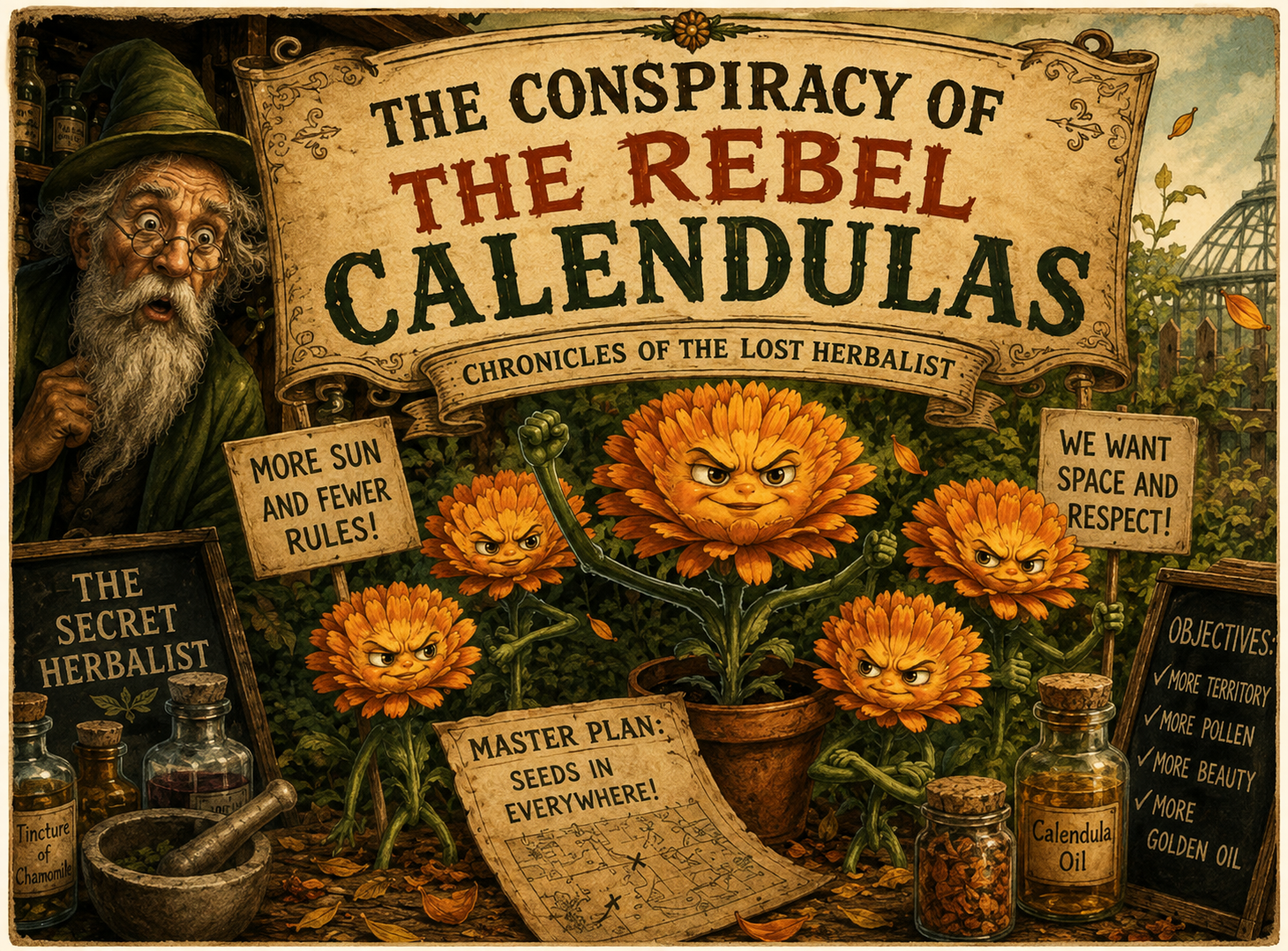
The Conspiracy of the Rebel Calendulas
A floral investigation involving suspicious petals, insubordinate flowerpots, and an herbalist who swore never again to underestimate an orange flower.
I. The Morning the Garden Lost Its Innocence
Until that day, the calendulas had been model citizens of the garden. They grew cheerfully, produced vivid orange flowers, and minded their own business. Or so we thought. Because plants, much like discreet neighbors, can know absolutely everything and say nothing until the perfect moment arrives.
The Mad Herbalist stepped into the yard with his cup of herbal tea, ready to inspect the mint, which was always suspected of invading neighboring territory without permission. But the mint was still. Too still. The rosemary pretended to stare into the distance. The lavender smelled calming, which was its preferred method of avoiding questions. And the calendulas… the calendulas had formed a perfect semicircle around the old stone bench.
This was no longer botany. This was organization.
“When one flower moves, it might be the wind. When thirty flowers move into formation, it isn’t the wind anymore. It’s a union.”
II. The First Clues: Petals in Compromising Places
The first incriminating piece of evidence appeared beside the shed: a calendula petal lying on top of the inventory book. That would not have been particularly alarming if the book had not been open to a page labeled “Seeds Awaiting Classification.” The second clue was even more disturbing: three flowerpots had been turned toward the east, directly facing the toolbox. The third was conclusive: someone had covered the dandelion’s label with soil.
At first glance, it could all have been coincidence. But the Herbalist understood the logic of the garden. One crooked flowerpot is an accident. Two crooked flowerpots are a draft. Three crooked flowerpots, a buried label, and a petal on an inventory ledger constitute, at the very least, an administrative violation.
Exhibit A
Orange petal on the seed inventory. Possible message: “We want more territory.”
Exhibit B
Flowerpots facing the toolbox. Possible attempt to gain access to small gardening shovels.
III. Who Are the Calendulas?
Before formally accusing them of conspiracy, a proper introduction is in order. Calendula is an annual or short-lived plant beloved in gardens and vegetable patches. Its flowers usually come in shades of yellow, gold, and orange, as though someone had bottled a sunset and planted it. It is hardy, generous, and fairly easy to grow.
In homemade skincare, calendula has traditionally been used in infused oils, balms, and salves. Not because it is some kind of magic wand, but because its flowers contain compounds that have inspired gentle skin preparations for centuries. It also attracts pollinators and brightens up almost any space with what could best be described as “botanical optimism.”
And therein lies the danger: a plant that useful begins as a guest and eventually starts believing it is indispensable. First it brightens your flower bed. Then it demands premium compost. Before long, it wants representation on the garden council. By the time you realize what is happening, the basil is calling it “Madam President.”
- Common name: calendula.
- Botanical name: Calendula officinalis.
- Typical colors: yellow, orange, gold.
- Special talent: looking innocent while enthusiastically taking up more space.
- Rebellion level: moderate, except in spring.
IV. The Secret Flower-Bed Council
The Herbalist’s theory was simple: the calendulas were holding secret meetings at night. The problem was proving it. So he installed a state-of-the-art rural surveillance system: a chair, a blanket, a notebook, and a thermos. At ten o’clock that night, he hid behind the bay laurel, convinced he was about to uncover a clandestine floral assembly.
At 10:15, all he heard were crickets. At eleven, the laurel dropped a leaf on his head. At midnight, just as he was considering mentally apologizing to the calendulas, a breeze moved through the flowers. Every one of them bowed its head at exactly the same time.
The Herbalist held his breath. The tallest calendula, standing in the center of the flower bed, appeared to be chairing the meeting. It did not speak, of course. Plants do not speak out loud, except in the literary sections of tasteful blogs. Still, the atmosphere said plenty: those flowers were deliberating.
“I heard no words, but I sensed intentions. And when orange intentions gather together, they can overthrow a calendar.”
V. The Demands of the Rebel Calendulas
The next morning, the Herbalist discovered a series of unmistakable signs. Several seeds had fallen in the shape of a circle. A number of flowers were pointing toward the compost bin. A dry leaf rested on the watering can like a protest note. He decided to translate the message with all the scientific rigor of a man who had spent far too much time talking to flowerpots.
Demand 1
More hours of direct sunlight and less shade from that arrogant sunflower.
Demand 2
Decent compost, not “sad dirt from a forgotten bag.”
Demand 3
Official recognition as a useful flower, not merely “cute decoration.”
The third demand stung. Because it was true. We often look at flowers as though their only purpose were decoration, when in reality they participate in an ecosystem full of relationships: they attract insects, grow alongside crops, provide visual shelter, and turn a vegetable garden into a place where people actually want to linger.
VI. Scientific Investigation: Rebellion or Natural Growth?
The Herbalist, who was dramatic but not irresponsible, launched an investigation. He examined the flower bed: the calendulas were spreading rapidly. They had produced seeds, some had germinated beside the path, and others seemed to have sprouted where no one had invited them. Botanically speaking, this was perfectly normal reproduction. Narratively speaking, it was a strategic occupation.
Calendula readily self-seeds when conditions are favorable. It does not need a master plan, only an opportunity. A seed falls, the soil is good, there is light and water, and suddenly you have a small floral colony cheerfully greeting the world. The garden is not conspiring. The garden is persistent.
| Observed Behavior | Botanical Explanation | The Herbalist’s Interpretation |
|---|---|---|
| Flowers facing the sun | Natural response to light | Military formation |
| Seeds scattered around the flower bed | Natural self-seeding | Territorial expansion |
| More plants growing beside the path | Successful germination | Control of trade routes |
| More vivid color after proper watering | Healthy, vigorous plant growth | Visual propaganda |
VII. The Golden Oil: The Evidence That Changed the Trial
The conspiracy took an unexpected turn when the herbalist’s apprentice, a practical young woman named Inés, asked: “If you’re so suspicious of them, why don’t you do something useful with their flowers?” The Herbalist was offended for exactly three seconds, his standard allotment of wounded pride, and then admitted that she had a point.
They gathered healthy, fully opened flowers after the morning dew had dried. They spread them on a cloth for several hours to reduce surface moisture. Then they filled a clean jar with petals and covered them with mild olive oil. The jar was placed in a warm spot away from direct light and gently shaken every day, like greeting an old accomplice.
Calendula-Infused Oil
- Clean, dry calendula flowers.
- Mild olive oil, almond oil, or high-oleic sunflower oil.
- A clean, dry jar.
- Leave the flowers on paper or cloth for a few hours to reduce moisture.
- Fill the jar without packing the flowers too tightly.
- Cover them completely with oil.
- Store for 3–4 weeks in a warm, dark place, shaking daily.
- Strain through a fine cloth and label with the date.
Result: a golden oil for external cosmetic use, ideal as a base for simple balms and salves. Do not apply to deep wounds or use as a substitute for medical care.
VIII. Interrogating the Suspects
While the oil infused, the Herbalist gathered the prime suspects: Senior Calendula, Pathside Calendula, Small-but-Intense Calendula, and one newly arrived flower that nobody remembered planting. The interrogation proved difficult, mostly because the calendulas responded with photosynthetic silence.
Nevertheless, the Herbalist pressed on:
“Do you confess to occupying three additional centimeters of garden space without authorization?”
The calendulas remained silent.
“Do you confess to making the area so beautiful that I’m beginning to question my own accusations?”
A bee landed on one of the flowers. The official record noted: “Possible witness bribed with pollen.”
The interrogation solved nothing, but it did reveal one important lesson: sometimes the garden does not need to be controlled; it needs to be listened to. And sometimes “listening” means no longer yelling at a plant simply because it has succeeded.
IX. The Rebellion Spreads to the Village
Word reached the village. At first it was merely a rumor: “The herbalist’s flowers have risen up.” Then it became legend: “The calendulas want to establish a republic.” Then it became a business opportunity: the baker began selling cookies called Rebel Petals. The barber offered a “revolutionary calendula-oil shave.” The mayor, ever the opportunist, proposed declaring the flower the official symbol of the town, “provided it doesn’t request a budget.”
The children were the first to side with the plants. They made orange paper crowns and marched through the town square shouting, “More flowers, fewer lectures!” The grandmothers, who knew more about gardening than all the council members combined, nodded approvingly. The rebellion was no longer merely botanical. It was aesthetic. It was communal. And it was extremely difficult to stop without looking like an enemy of spring.
X. The Garden Assembly
To prevent matters from getting out of hand, the Herbalist called an assembly. Representatives from the rosemary, sage, lavender, mint, thyme, and, naturally, the calendulas all attended. The mint arrived late because it had been busy invading a neighboring pot. The lavender requested that everyone keep their voices down. The rosemary demanded official minutes because “memory matters.”
The Herbalist’s Position
“The garden needs order. We cannot allow every flower to self-seed wherever it pleases. Today it’s calendulas; tomorrow we’ll be living under a nasturtium dictatorship.”
The Calendulas’ Position
“The garden also needs joy, pollinators, and room for spontaneity. Besides, we look good with everything.”
The meeting lasted two hours. Not because there was much to discuss, but because every time someone looked at the calendulas, they forgot why they were angry. That is one of their most dangerous talents: they look like solutions before anyone has even explained the problem.
XI. The Floral Peace Agreement
At last, the Treaty of the Golden Flower Bed was signed, a historic document written on recycled paper and decorated with a petal that had fallen there entirely by accident. The treaty established the following:
- The calendulas would be allowed to self-seed within designated areas.
- The Herbalist would collect seeds at the end of the season to prevent chaotic expansion.
- A strip of the garden would be reserved for pollinator-friendly flowers.
- The mint would remain under special surveillance.
- Any cosmetic use of calendula would be labeled with the date and a healthy dose of common sense.
Peace returned to the garden. Or at least a very orange version of peace.
XII. Practical Guide: How to Grow Calendulas Without Letting Them Take Power
A Quick Guide for the Cautious Gardener
- Light: they prefer full sun, although they tolerate some partial shade.
- Water: moderate. Avoid waterlogged soil.
- Soil: light and well-drained.
- Sowing: direct sow in spring or during a mild fall, depending on your climate.
- Control: remove spent flowers if you do not want them self-seeding too aggressively.
- Harvest: pick open flowers on dry days.
XIII. Creative Uses at The Secret Herbalist
Once the conflict had been resolved, the Herbalist decided to channel the calendulas’ revolutionary energy into useful projects. Because if a flower insists on being the center of attention, the best thing you can do is give it a job.
1. Golden Oil
A base for cosmetic balms and gentle massage oils. For external use only.
2. Bath Salts
Dried petals mixed with coarse salt and ground oats. Pretty and aromatic.
3. Decorated Paper
Pressed petals for cards, labels, or botanical journal pages.
XIV. Recipe: Bath Salts of the Orange Rebellion
Ingredients
- 1 cup coarse salt or Epsom salt.
- 2 tablespoons dried calendula petals.
- 2 tablespoons finely ground oats.
- Optional: 1 teaspoon calendula-infused oil.
- Mix the salt and oats together.
- Add the dried petals.
- If using oil, stir very thoroughly to prevent clumping.
- Store in a dry jar and use 2–3 tablespoons in a short bath.
Result: a gentle, visually beautiful bath with the appearance of a perfectly civilized floral ritual.
XV. The Final Trial of the Calendulas
The Herbalist organized a ceremonial trial. Not because one was necessary, but because he had purchased a little bell and wanted an excuse to use it. The charges: conspiracy, unauthorized expansion, and excessive visual charm. The defense: services rendered to the garden, public beautification, and support for pollinators.
The jury consisted of three flowerpots, one bee, two children, and the lavender, which fell asleep halfway through the proceedings. After deliberation, the verdict was clear:
“Guilty of bringing joy to the garden. Innocent of wrongdoing. Sentenced to bloom responsibly.”
The calendulas accepted the verdict with dignity. Or perhaps they simply continued photosynthesizing, which for them amounts to more or less the same thing.
XVI. What We Learned From the Conspiracy
The great lesson of that week was that disorder in the garden is not always the enemy. Sometimes spontaneity brings life. A plant that self-seeds can certainly become a nuisance if it spreads too aggressively, but it can also be a gift when it appears in a place that needed a little color. As with so many things in nature, the key is to observe before pulling things out.
The calendula was not a conspirator. It was a radiant opportunist. A flower that took advantage of good soil, generous sunshine, and administrative neglect to remind the Herbalist that a garden is not a piece of furniture: it is a conversation.
And every living conversation contains interruptions, laughter, changes of subject, and the occasional flower raising its hand without permission.
XVII. Epilogue: The Orange Republic
Tags
calendula chronicles of the lost herbalist the secret herbalist medicinal plants rebel garden botanical humor calendula oil natural remedies useful flowers