Step into the fascinating world of henna in the Middle East and North Africa. History, symbolism, wedding traditions, uses on skin and hair, homemade recipes, storage and cultural meaning. A complete guide, written the way I’d tell you about it over coffee.
What henna really is.
These days most people associate it with temporary tattoos or natural hair dye, but henna is so much more than that. It comes from a plant called Lawsonia inermis. Once the leaves are dried and ground, they release a molecule called lawsone, which stains skin, nails and hair a reddish or brown tone. What’s really interesting, though, isn’t just its ability to dye things — it’s everything it stands for.
Where henna comes from in the Middle East and North Africa.
The story of henna goes back a very long way. Archaeological finds suggest it was being used more than 5,000 years ago in:
• Egypt.
• Morocco.
• Arabia.
• Yemen.
• Sudan.
• Tunisia.
• Libya.
Women used it to:
• stain their nails.
• decorate their hands and feet.
• cool the body in hot climates.
• protect themselves spiritually.
It’s also thought to have been used in royal mummification in ancient Egypt, which tells you a great deal about how much it mattered.
Henna as a cultural and spiritual symbol.
This is one of the parts that moves me most. For many women across these regions, henna isn’t simply about how it looks. It stands for protection, fertility, prosperity, beauty, celebration and connection to the women around you.
When a woman applies henna, especially at a significant moment, she isn’t only decorating her skin. She’s taking part in a ritual that goes back generations.
Henna at weddings.
In countries like Morocco and Yemen, the henna night is one of the most eagerly awaited moments before a wedding. The bride gathers with the women of her family and her friends to mark the start of her new chapter.
There’s singing and dancing, the bride is blessed, and symbolic designs are drawn onto her skin.
And the loveliest part is that each stroke can carry its own meaning:
• protection from the evil eye.
• a wish for fertility.
• lasting love.
• joy in the marriage.
It’s rather like writing a wish onto the skin.
Henna as protection.
In many cultures across the Middle East and North Africa, henna is believed to ward off negative energy, with the designs acting as temporary amulets. It’s no accident that they’re placed on the palms and the soles of the feet — the places where, according to tradition, energy enters and leaves the body.
Henna as a natural dye.
Alongside its ritual use, henna has been the natural dye of choice for centuries. It was used to colour hair and strengthen it, to add shine, to stain nails and to dye textiles.
And the best part is that it still holds up today as a natural alternative to chemical dyes.
Henna on hair: tradition and beauty.
In countries like Morocco and Egypt, plenty of women still use henna to look after their hair. It doesn’t just colour: it coats and strengthens the hair shaft, adds body, and is traditionally credited with calming the scalp, keeping oiliness in check and offering a little protection from the sun.
It’s a whole treatment in itself.
Henna on nails and skin.
Long before modern nail polish existed, women were already decorating their nails and skin with henna — to look beautiful, to signal their marital status and to protect themselves spiritually.
Even now, brides in some regions stain their fingertips as a mark of celebration.
Henna across the Middle East and North Africa.
Morocco.
In Morocco, henna is far more than decoration — it’s part of the cultural identity.
Traditionally, the paste is made with ground henna leaves, lemon juice, brewed tea and aromatic oils, sometimes eucalyptus.
At weddings, the henna ceremony — Laylat al-Henna — is celebrated with music, dancing, gifts, traditional songs and sweets. The bride usually wears the most elaborate designs on her hands and feet, while guests and relatives receive simpler ones, as a symbol of the bond between the women present.
Egypt.
In Egypt, henna goes back an extraordinarily long way. Traces have been found on ancient Egyptian mummies, particularly on the nails and hair — a sign of status, of preparation for the afterlife, and of caring for the body even after death.
Yemen.
In Yemen, henna carries a very strong spiritual meaning. It’s a symbol of joy, of protection and of women celebrating together.
The traditional preparation includes:
• henna.
• clove.
• coffee.
• oil.
Sudan.
Sudan is one of the places where henna reached its most artistic heights. The designs are dense, detailed, boldly outlined and heavy with symbolism. Traditional Sudanese henna can cover large areas of skin, especially at weddings.
Saudi Arabia.
In Saudi Arabia, henna is tied to religious celebrations such as Eid, to the birth of a baby and to weddings. Women tend to gather at home and apply it while sharing stories, music and food.
Henna design styles.
One of the most beautiful things about this art form is that the designs speak. Every style says something different.
Arabic style.
What defines it:
• large motifs.
• flowers.
• leaves.
• plenty of open space.
Very elegant, and very delicate.
Indian style.
It isn’t from the Middle East or North Africa, but it has hugely influenced the region. What defines it:
• intricately detailed patterns.
• fine lines.
• designs that cover the whole hand.
North African style.
What defines it:
• geometric shapes.
• diamonds and triangles.
• bold, angular lines.
• solid blocks of colour.
Many of these motifs draw on Amazigh (Berber) symbols, the same ones you’ll find woven into rugs and stamped into silver jewellery. This is where henna really becomes a visual language.
What the symbols mean.
I love this part, because it shows that every stroke is deliberate.
Triangles.
They stand for womanhood, fertility and protection of the home.
The eye.
It represents protection from the evil eye.
Flowers
They stand for beauty, joy and love.
Birds.
They represent freedom and wishes for a happy future.
Henna as a women’s ritual.
One of the most precious things about this tradition is that henna is so often a ritual by women, for women. It isn’t only about the result but about the process: gathering, talking, singing, sharing experiences and getting the bride ready emotionally. It’s a moment of real connection. In many cultures a woman is stepping into a new phase of her life, and henna marks that change.
How the paste is traditionally prepared.
Here’s where it gets most ritual and most meaningful. In many cultures, preparing the henna matters almost as much as applying it.
The traditional paste is built from:
• fresh henna powder.
• lemon juice or tea.
• sugar.
• aromatic oils.
Every ingredient is there for a reason.
Why lemon or tea.
The acidity of lemon or tea helps release the lawsone pigment from the leaf. The better that pigment is activated, the deeper the colour.
Why sugar goes in.
I loved this detail when I first came across it. Sugar makes the mixture more elastic, helps the paste cling to the skin and stops it cracking as it dries.
The aromatic oils.
Traditionally, people added:
• eucalyptus oil.
• clove.
• cinnamon.
Not just for the scent: these oils are rich in terpenes, which help the dye bind to the skin and give a noticeably darker stain.
Some people swap them for a fragrance oil these days, but the traditional versions do a better job. Do go carefully, though — clove and cinnamon are strong on the skin, so keep them to a few drops and patch test if you’re at all sensitive.
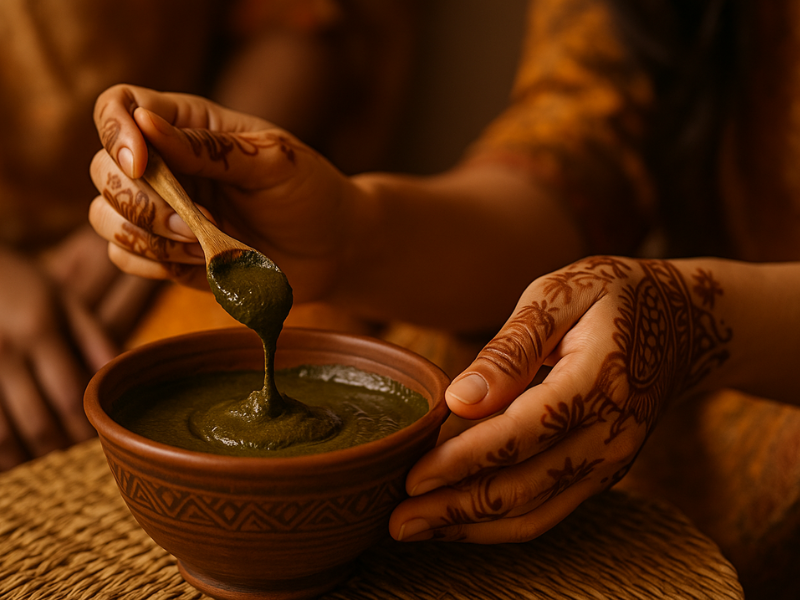
Traditional henna paste recipe for skin.
Here’s the recipe I learned, and it works beautifully.
Ingredients.
• 3 tablespoons of fresh henna powder.
• 1 tablespoon of lemon juice or strong black tea.
• half a teaspoon of sugar.
• 3–4 drops of eucalyptus or clove essential oil.
• warm water to adjust the texture.
Step by step.
- Mix the henna with the lemon juice or tea until you have a thick paste.
- Add the sugar and stir it through.
- Add the essential oil.
- Add water a little at a time, until it’s smooth.
- Cover the bowl and leave it to rest for 6–12 hours.
This bit matters: henna needs that resting time to release its pigment.
How to apply henna to skin.
Applying henna is an art, but it’s absolutely something you can do at home.
Prepping the skin.
Before you start, wash the area well, dry it completely and skip any cream or oil. The skin needs to be clean for the pigment to take.
What to apply it with.
You can use:
• traditional cones.
• small bottles with a fine nozzle.
• cocktail sticks.
• a needle-free syringe.
Cones are the easiest if you’re just starting out.
How long to leave it on.
This step is the key one: the longer the paste stays on the skin, the darker the colour and the longer it lasts. Three hours is the minimum, six if you can manage it. Some women sleep with it on.
How to get a darker colour.
This is one of the best-kept secrets.
Gentle warmth.
Heat helps the pigment develop. You can hold the area near some warm steam for a moment, or wrap it in a warm cloth.
Sealing the henna.
Once the paste has dried on the surface, dissolve a little sugar in lemon juice and dab it over the design with a cotton pad. It keeps the paste damp and stuck to the skin for far longer, and that extra contact time is what deepens the stain.
Don’t rinse it off with water.
This is a really common slip-up.
Once you take the paste off:
❌ don’t rinse the area with water.
Instead:
– scrape the dried henna away.
– rub in a little oil (olive, coconut or almond).
Water in those first few hours will lighten the colour.
Keeping leftover paste.
Another important one. Fresh henna always stains best, but if you have paste left over you can keep it in an airtight jar in the fridge for up to 3 days, or in the freezer for up to 6 months. Freezing keeps the pigment active.
Common mistakes with henna on skin.
This list will save you a lot of disappointment.
Using “black henna”.
This one really matters.
So-called “black henna” is NOT henna. It usually contains PPD, a chemical that can cause severe allergic reactions, chemical burns and permanent scarring. Please never use it — and be wary of anyone at a market or on a beach offering a design that will turn black within an hour, because real henna simply doesn’t do that.
Not letting the paste rest.
If you apply the paste as soon as you’ve mixed it, the colour will be weak and won’t last.
Rinsing with water straight away.
It lightens the pigment and spoils the design.
How long a henna design lasts.
A good design will usually last between 5 and 15 days, depending on how you look after it, where it is on the body and your skin type. Palms and soles take the deepest colour, because the skin there is thicker and has far more layers of keratin for the dye to bind to.
Henna on hair: centuries of natural beauty.
Plenty of us in Spain have only discovered henna recently, but across the Middle East and North Africa it has been the star hair treatment for centuries. Women there used it as a natural dye, a strengthening treatment, a shield against the sun and a beauty ritual all in one. What I find most interesting is that they never saw it as purely cosmetic, but as genuine care.
They’d spend hours preparing it while swapping stories, songs, family recipes and beauty tips. It was both intimate and communal.
What henna really does for hair.
This comes from my own experience as much as from everything I read while looking into it. Henna coats and strengthens the hair shaft, gives real shine, adds body, makes fine hair feel noticeably thicker and covers greys gradually. It’s also traditionally used to calm the scalp, keep oiliness in check and offer some protection from the sun.
All of that without harsh chemicals, which is why so many women come back to it after struggling with chemical dyes, irritation, allergies and split ends.
How henna works on hair.
Henna doesn’t penetrate the way chemical dyes do. What it does is bind to the keratin in your hair, forming a protective layer that catches the light. That’s why the result is so distinctive: it doesn’t replace your colour the way a synthetic dye would, it transforms whatever you already have.
The shades pure henna can give you.
This is important: pure henna ONLY gives reds, coppers and oranges.
It can’t lighten your hair, turn it blonde or give you a deep black on its own.
Knowing that upfront saves a lot of disappointment. Across the Middle East and North Africa this has always been understood, which is exactly why henna is blended with other plants.
Henna on dark hair.
On brown or dark hair, henna gives mahogany glints, shine and a warmer tone overall.
Henna on light hair.
On blonde or light brown hair, expect a strong copper.
Henna and grey hair.
This is one of the most sought-after uses. It’s used constantly across the region to cover greys, but there’s one thing you should know going in: henna turns greys a coppery shade, so they end up lighter than the rest of your hair. Rather than looking patchy, it tends to read as natural highlights — but it’s worth trying a strand test first so you know exactly what you’re getting.
Traditional henna recipe for hair.
Here’s a simple, effective version based on the traditional recipes.
Ingredients.
• 100 g of fresh henna powder for shoulder-length hair (50 g for short hair, 200 g or more for long).
• strong warm black tea or coffee, roughly 300 ml, added gradually.
• 1 tablespoon of lemon juice (optional, and best left out if your hair is dry).
• 1 tablespoon of olive or coconut oil.
• a few drops of eucalyptus or clove essential oil.
Step by step.
- Put the henna powder in a non-metal bowl.
- Add the warm tea a little at a time, stirring as you go.
- Keep going until you have a yoghurt-like consistency — thick enough not to drip.
- Stir in the oil, and the lemon juice if you’re using it.
- Cover and leave to rest for 6–12 hours somewhere warm.
Applying it to your hair.
It takes patience, this one, but it’s worth it.
Prepping your hair.
Wash with shampoo first, skip the conditioner and towel-dry only. Your hair needs to be clean so it can take the henna properly.
Applying.
Section your hair, work from the roots outwards and make sure every strand is properly coated. Wear gloves, cover your shoulders and wrap your head in cling film or a shower cap once you’re done.
How long to leave it on.
Here’s the big secret: the longer you leave it, the deeper the colour.
– 1 hour minimum.
– 3–4 hours ideally.
– some women sleep in it.
The result.
When you rinse it out, the colour starts off orange, but it oxidises over the next 24–48 hours and settles into something darker and much more natural. That’s completely normal, so don’t panic.
Storing hair henna.
If you’ve got paste left over, freeze it. It holds on to its pigment that way and you can use it another day.
Common mistakes with henna on hair.
This will save you some grief.
Mistake 1 — Unrealistic expectations.
Henna doesn’t lighten hair.
Mistake 2 — Washing it straight after.
It lightens the colour before it’s had a chance to settle.
Mistake 3 — Not letting the mixture rest.
Without those hours of resting time, the lawsone never fully releases and the colour comes out weak.
Mistake 4 — Conditioning beforehand.
It leaves the hair slippery, and the pigment can’t take hold.
Mistake 5 — Buying adulterated henna.
A lot of cheap hennas contain metallic salts, PPD and chemical colourants that can damage your hair — and react badly with anything you put on it afterwards.
Storing henna generally.
Storing the powder.
To protect the lawsone, keep the powder in an airtight container, away from light, somewhere cool, dry and out of any damp. If you live somewhere hot, you can even keep it in the fridge.
Signs your henna is past it.
Henna loses its strength when the powder turns a dull brown, when it smells earthy or stale rather than green and herbal, and when the final colour comes out weak.
Good henna usually has a deep olive-green tone.
Storing mixed paste.
Fresh paste always stains best, but if you need to keep some:
– 3 days in the fridge.
– up to 6 months in the freezer.
Freezing doesn’t destroy the pigment, so it’s a brilliant way to make a batch go further.
Henna today.
What I find fascinating is that, for all its thousands of years of history, henna is still very much alive. Across the Middle East and North Africa it remains part of weddings, religious festivals, births, family celebrations and women’s rituals.
On top of that, it’s become a beauty trend, a natural alternative to chemical dyes and a form of temporary body art.
Henna in Spain today.
Here in Spain, more and more people are discovering henna:
• to cover greys without damaging their hair.
• as temporary body art.
• for events.
• as a natural alternative to chemical dye.
It’s grown enormously in beauty salons, natural hair studios, organic fairs and on social media. And, interestingly, one of the most common searches is:
“henna weddings Spain”
because a lot of brides want to bring something symbolic and a little different into their big day.
What it symbolises now.
Plenty of people no longer know the traditional meanings, but something lovely has survived: henna is still a moment of looking after yourself.
When you sit down to apply it, you give yourself time, you reconnect with yourself, you change how you look in a completely natural way and you celebrate your own body. And that, to me, is a modern ritual.
Frequently asked questions about henna.
Is henna safe?
Generally yes, as long as it’s pure henna. Steer well clear of “black henna”, which usually contains dangerous chemicals, and patch test first if your skin tends to react.
Does it stain permanently?
No. On skin it lasts between 5 and 15 days.
On hair it hangs around longer, but it softens gradually.
Can it be used during pregnancy?
In most cases yes, but it’s always best to check with a professional first and to leave out strong oils such as clove or cinnamon.
Does henna lighten hair?
No. It only adds warm tones.
Can I mix henna with other dyes?
Combining it with chemical dyes is risky, since it can react badly if the henna contains metallic salts.
You’re far better off blending it with other plants.
How do I get henna off my skin faster?
Exfoliate gently and rub in some oil. Swimming and salt water will fade it more quickly too.
After reading about it, trying it and living with it, I’ve come to feel that henna is far more than a dye. It’s history, beauty, connection between women, symbolic protection and natural care all at once.
Every time I mix a bowl of it, I feel like part of a thread that links women thousands of years and thousands of miles apart. And I love that.
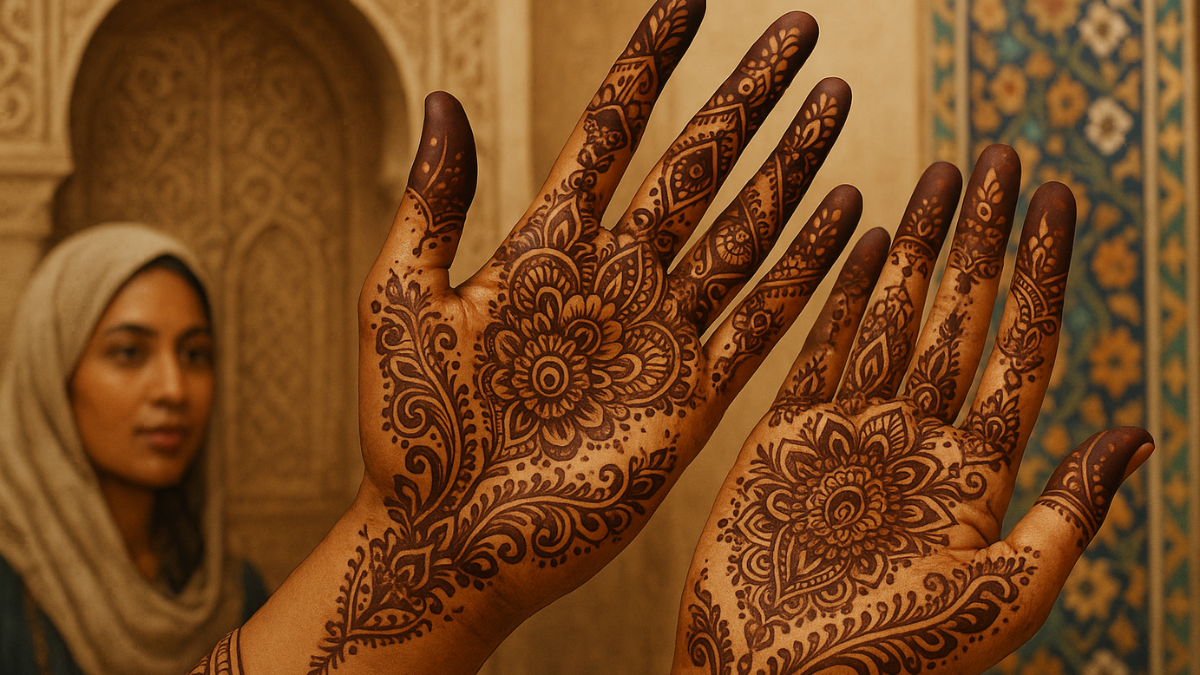
How to prepare and apply traditional henna to decorate the skin with a deep, long-lasting colour
Total Time: 12 hours
Mix the paste
Mix the henna with lemon juice or tea until it forms a paste.
Add sugar and oil
Stir in the sugar and the essential oil.
Adjust the texture
Add warm water a little at a time until it’s smooth.
Leave it to rest
Cover the bowl and rest for 6-12 hours.
Apply to clean skin
Wash and dry the area first, with no cream or oil on it.
Let it dry
Leave the paste on for at least 3 hours, 6 if you can.
Remove and oil
Scrape the dried paste off without water, then rub in some oil.
Tools:
- bowl, spoon, applicator cone
Materials: henna powder, lemon juice or tea, sugar, essential oil, warm water
Tell me how you get on.
Have you tried henna? Would you use it on your hair, your skin, or for a celebration?
Tell me in the comments — I’d love to hear from you, and to keep making more about this beautiful world together!
And if you’d like to read more about ancient beauty secrets, have a look around the blog!