Discover what jojoba oil can really do: a natural ingredient that hydrates, balances and repairs, leaving skin and hair looking their best. Here’s where it comes from, what it actually does, how to use it, how to store it, the different types out there and my own experience with it.
Today I want to talk about one of my all-time favourite oils. It’s the one I reach for when my skin looks dull, when my hair is crying out for help, when I need something that actually works. I’m talking about jojoba oil — a little natural treasure that completely changed the way I look after myself.
I know there are hundreds of oils out there in the world of natural skincare, but jojoba has something about it. It’s light, it sinks in fast, it doesn’t leave skin greasy and it’s useful for pretty much everything. It’s one of those ingredients that seems to understand what your skin needs and get to work exactly where it’s needed.
I still remember the first time I tried it. I bought it for the ends of my hair and it ended up becoming one of my essentials. Over time it worked its way into my face, body and hair routine. These days I use it in masks, mixed into creams, as a makeup remover, in homemade scrubs — even on my lips when they get dry.
1. What jojoba oil actually is.
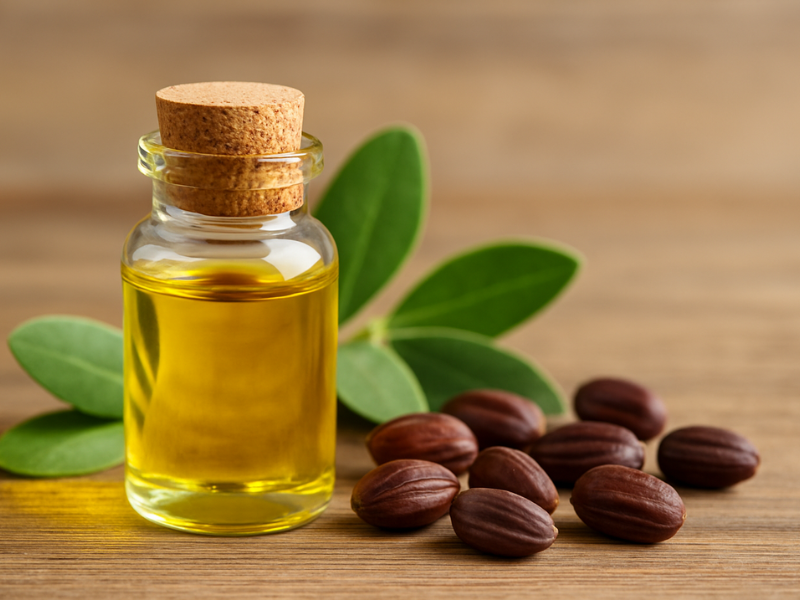
Even though we all call it an oil, jojoba isn’t really an oil at all. It’s a liquid wax pressed from the seeds of a shrub native to northern Mexico and the southern United States. Its make-up is remarkably close to human sebum, which is why our skin recognises it so readily and drinks it in so easily.
That’s a big part of why it’s so good at balancing things out. If your skin is oily, it can help keep excess sebum in check. If it’s dry, it nourishes. If it’s sensitive, it soothes. And if it’s mature, it softens and brings back a bit of glow.
It’s a bit of an all-rounder.
1.1 A make-up that’s hard not to love.
Jojoba oil is generally credited with vitamins E and B, minerals such as zinc and copper, natural antioxidants and compounds that help shield the skin from environmental damage.
It also stands up to oxidation remarkably well, so it lasts far longer than most vegetable oils.
1.2 Light texture, silky finish.
One of the things I like most is how quickly it sinks in. Skin is left soft, with none of that greasy feeling. Perfect if you like looking after your skin without any heaviness.
1.3 A soft, natural scent.
It barely smells of anything. For me that’s a plus, because I can blend it with essential oils or use it as it comes without any strong scent getting in the way.
2. A short history of jojoba oil.
Jojoba is no modern fad. Indigenous communities of the Sonoran Desert were already using the seeds to care for their skin, soothe wounds and protect themselves from the sun. It was a prized ingredient because it kept skin supple, even in a harsh, bone-dry climate.
Over the years it took off as a natural alternative to sperm whale oil, which had been widely used in cosmetics before it was banned. That was its big break, and jojoba oil has been building a reputation ever since for its stability, its unusual make-up and the way it seems to balance every skin type.
And now we can pick it up almost anywhere. That feels like a bit of a luxury to me.
3. What jojoba oil does for your skin.
This is where the magic starts, because if there’s one thing this oil has going for it, it’s that it suits just about every skin type: dry, combination, oily, sensitive, mature and young.
3.1 Hydrates without the grease.
Because its structure is so close to your skin’s own sebum, it hydrates without tending to block pores.
Ideal if your skin turns oily at the drop of a hat.
3.2 Helps keep oil in check.
This is the clever bit. The thinking is that when skin is properly hydrated, it stops overproducing oil to compensate — and jojoba is thought to send exactly that signal.
3.3 May help with blemishes.
It rates very low on the comedogenic scale, so it doesn’t usually clog pores, and it’s often said to have mild antibacterial properties that can help with the odd spot and blackhead.
3.4 Softens the look of fine lines.
Its antioxidants help keep skin supple and looking fresh.
3.5 Calms irritation.
For sensitive skin, it’s worth its weight in gold.
3.6 Supports the skin barrier.
It helps protect against dryness, wind, cold and pollution.
3.7 A lovely natural makeup remover.
It dissolves makeup gently, without stinging your eyes.
3.8 Brings back a bit of glow.
I’m not sure whether it’s the texture or just the way it settles on the skin, but it leaves the loveliest healthy sheen.
4. What jojoba oil does for your hair.
If you’ve never tried it on your hair, brace yourself. It’s one of those ingredients you’ll wish you’d found sooner.
4.1 Nourishes without weighing hair down.
Great for dry ends, frizz and hair that’s lost its shine.
4.2 Balances the scalp.
If you’re oily at the roots and dry at the ends, you’ll love it.
4.3 Adds natural shine.
Without the greasy look.
4.4 Smooths split ends.
It can’t actually mend a split, but used regularly it coats and smooths the ends so they look better and are less likely to keep breaking.
4.5 May help with flakes.
Thanks to the way it helps balance the skin on your scalp.
5. How to use jojoba oil on your skin.
Here’s every use I’ve tried so far, and how each one works best for me.
5.1 As a facial moisturiser.
A few drops on damp skin is all you need. I put it on after cleansing and before my cream, or mix it straight into the cream itself.
5.2 As a makeup remover.
A few drops on a cotton pad or in your hands, massage it in, rinse off with warm water and follow with your usual cleanser.
5.3 As a night serum.
You wake up with that plump, dewy look.
5.4 On dry lips.
I find it does a better job than a lot of balms.
5.5 On sensitive or eczema-prone skin.
It can be really soothing and helps skin feel more comfortable. If you’re managing eczema, it’s best used alongside whatever your doctor has recommended rather than instead of it.
6. How to use it on your body.
6.1 Straight after a shower.
On skin that’s still damp — a few drops will do it.
6.2 On stretch marks or scars.
It won’t make them disappear, but it keeps skin supple and can soften how the texture looks and feels.
6.3 As a massage oil.
Lovely blended with a relaxing essential oil or two.
7. How to use it on your hair.
7.1 As a pre-wash treatment.
Work it through the mid-lengths and ends about half an hour before you shower.
7.2 On dry ends.
Two drops once you’ve brushed your hair out.
7.3 On your scalp.
Either to keep oiliness in check or to give a dry scalp a bit of moisture.
8. The different types of jojoba oil.
There are a few kinds on the shelves.
8.1 Virgin jojoba oil.
The purest one, and golden in colour. It’s the one I go for.
8.2 Refined jojoba oil.
Paler, with a milder smell. Handy if you want something completely neutral.
8.3 Organic jojoba.
Worth it if you’re after top quality and sustainable packaging.
9. Homemade recipes with jojoba oil.
And here come my favourite blends.
9.1 Hydrating serum.
Jojoba.
Aloe vera.
Lavender.
9.2 Brightening serum.
Jojoba.
An oil-soluble vitamin C, such as tetrahexyldecyl ascorbate (plain vitamin C powder won’t dissolve in oil).
Geranium.
9.3 Body scrub.
Ground coffee.
Jojoba.
Vanilla.
9.4 Nourishing hair mask.
Jojoba.
Coconut oil.
Honey.
10. How to store jojoba oil.
It’s one of the most stable oils around, but these few habits help.
- Keep it in a dark glass bottle.
- Keep it out of direct light.
- Don’t leave it anywhere hot.
- Screw the cap on properly.
Stored well, it’ll easily keep for a year or more.
11. Anything to watch out for.
Jojoba oil is generally very well tolerated, but if you have a nut or seed allergy, try it on a small patch of skin first. The same goes if your skin tends to react to new products.
12. My own experience.
Jojoba oil turned up in my life without any fuss and never left.
It got me through dry spells, oily breakouts and those stressful stretches when everything seemed to irritate my skin.
I keep one in the bathroom, another on the bedside table and a mini bottle in my bag.
It’s versatile, gentle and it does the job.
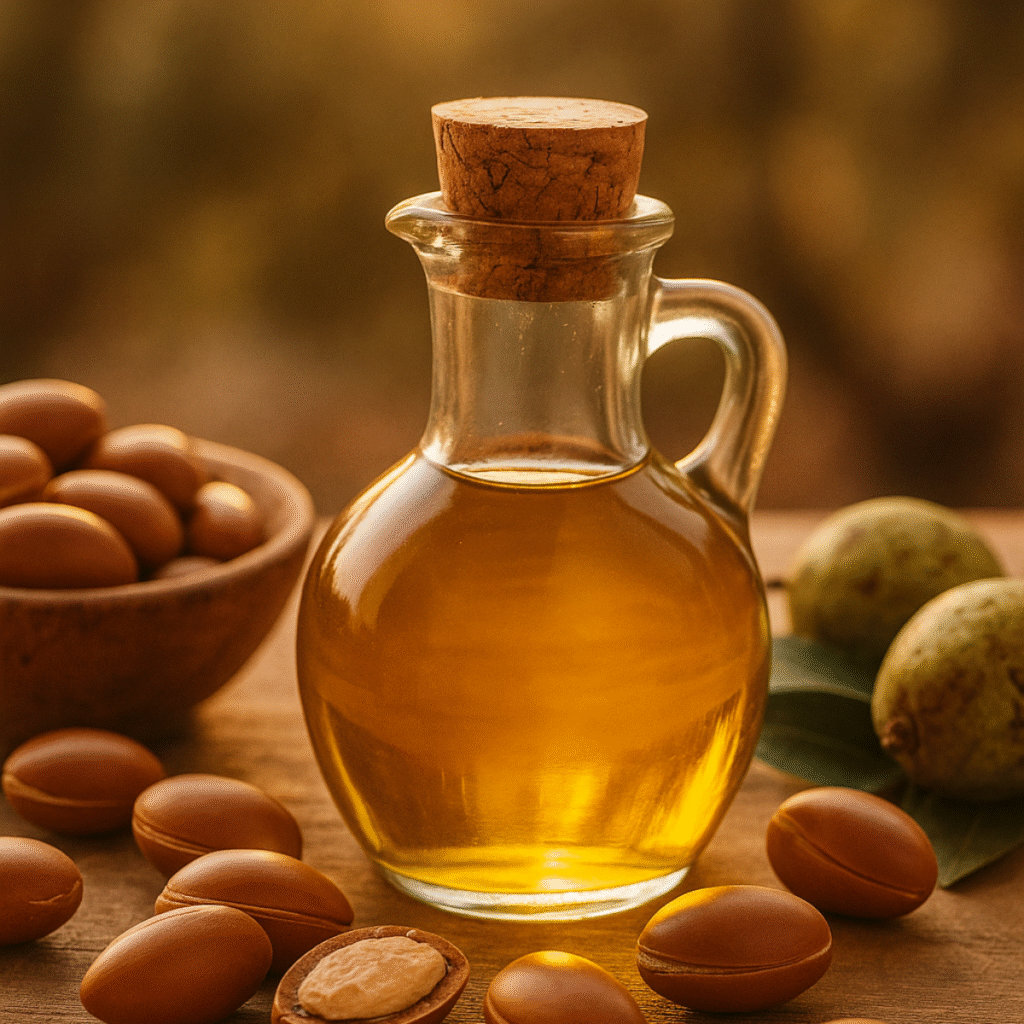
It’s the oil I’d recommend over and over again, because it works. And because it smells of natural care, of calm, of feeling well. This one and argan oil are both wonderful!
13. Frequently asked questions
Is it good for oily skin?
Yes, it’s one of the best options out there.
Is it comedogenic?
It rates very low on the comedogenic scale, so it doesn’t tend to clog pores.
Can I use it on babies?
Generally yes, as long as it’s 100% pure. Patch test first and check with your health visitor or paediatrician.
Can I use it every day?
Absolutely.
Can I mix it into my creams?
Yes, it blends in beautifully.
Jojoba oil is one of those ingredients you discover and never let go of again.
It’s gentle, balancing, natural and endlessly versatile. It works on your face, your hair, your body, and in all sorts of homemade recipes that leave you feeling good.
If you’re after something natural, effective and kind to your skin, this oil is for you.
Now over to you: have you tried it? Would you like me to put together some specific recipes using it?
I can’t wait to read your comments.