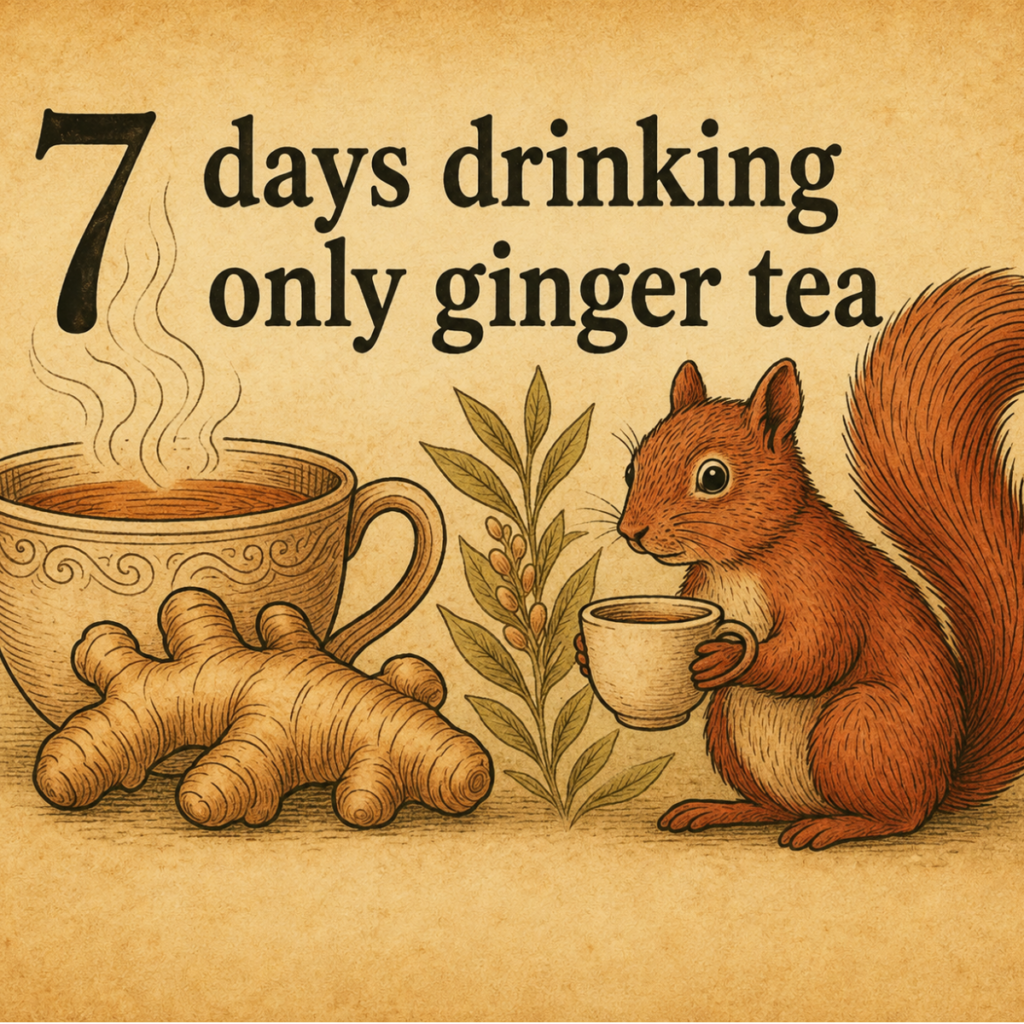
Can ginger tea be your only drink for a week? Discover the quirkiest challenge from the Secret Herbalist: seven days of infusions, natural science, and humor. Real results, recipes, myths debunked, and even an imaginary squirrel.
7 days drinking only ginger tea, did I survive or turn into a squirrel?
An unlikely chronicle of an absurd challenge — with ginger science, kitchen humor, and a responsible ending.
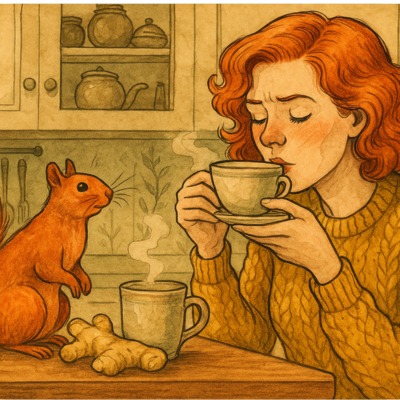 Some challenges make you a better person. This one, frankly, makes you a better storyteller. “Seven days drinking only ginger tea”
sounds heroic, minimalist, and a little crazy. Just in case, here comes the responsible spoiler: don’t follow “only X” diets.
In this playful chronicle, we toy with the idea to explore the sensory science of Zingiber officinale,
its place in the folklore of coughs and digestion, and what happens when you test your patience (and your taste buds)
with a cup that appears in every scene. Did I survive? Yes. Did I turn into a squirrel? Only in the hyperactivity of my metaphors.
Some challenges make you a better person. This one, frankly, makes you a better storyteller. “Seven days drinking only ginger tea”
sounds heroic, minimalist, and a little crazy. Just in case, here comes the responsible spoiler: don’t follow “only X” diets.
In this playful chronicle, we toy with the idea to explore the sensory science of Zingiber officinale,
its place in the folklore of coughs and digestion, and what happens when you test your patience (and your taste buds)
with a cup that appears in every scene. Did I survive? Yes. Did I turn into a squirrel? Only in the hyperactivity of my metaphors.
- This challenge is narrative and humorous. Don’t follow single-food diets. Your body needs a varied diet.
- Ginger tea is usually well tolerated, but it can cause heartburn or stomach discomfort if you overdo it.
- If you take anticoagulants, have gallstones, are pregnant, or have digestive conditions, consult a professional before using ginger regularly.
- If you experience a high fever, chest pain, shortness of breath, a persistent cough, or dehydration, seek medical attention.
I. The setup (or how a root became the main character)
Ginger has a strange charisma: it bites without apologizing and leaves a pleasant warmth in your throat. During winter after-dinner conversations, its name comes up every other story: “it soothes my cough,” “it settles my stomach,” “it wakes me up better than coffee in the afternoon.” With so much enthusiasm around it, I set myself the month’s silliest and most discussable experiment: drinking ginger tea at all the moments when I would normally reach for something else. Not as my only “food,” but as an omnipresent companion ritual. The title stayed to attract the minstrels.
Rules of the game (sensible ones)
- Drink 3–5 cups of ginger tea a day, in different versions.
- Maintain a normal and varied diet (narrative challenge ≠ diet).
- Record effects on the throat, digestion, perceived energy, and mood.
- Avoid excessive amounts: 2–4 g of fresh ginger per day divided among infusions is more than enough for a trial.
Homemade scales
- Throat comfort (1–5): 1 = burning / 5 = silk.
- Light digestion (1–5): 1 = hot-air balloon / 5 = breeze.
- Cozy mood (1–5): 1 = ogre / 5 = poet with a blanket.
II. Friendly ginger science (why you “feel” it so much)
Ginger contains aromatic and pungent compounds —gingerols and shogaols— that stimulate sensory receptors for heat and spiciness. In the mouth and throat, that gentle stimulus can feel relieving; in the stomach, some people notice relief from mild nausea and sluggish digestion. Infusions are not magic potions: they are sensory experiences wrapped in routine. Warmth + aroma + a pause can do as much as the chemistry.
III. Basic recipe (the one that saves mornings)
Mild ginger infusion
- 250–300 ml of nearly boiling water
- 3–4 thin slices of fresh ginger (≈ 6–8 g)
- Optional: 1 teaspoon of honey or a drop of lemon
- Turn off the heat, add the ginger, and cover for 5–7 minutes.
- Strain and taste. Add more water if it “bites” too much.
Sensation: pleasant warmth, easier breathing, awakened tongue.
IV. Challenge diary (7 days with root and patience)
Day 1 — Introductions
I start enthusiastically. Morning with a mild infusion; afternoon with thyme + ginger; evening with a discreet touch of honey. Throat 4, digestion 3, mood 4. I end the day certain that ginger asks for respect and offers warmth in return.
Day 2 — Finding the right heat
I try 10 g of ginger in the same cup (beginner mistake). The heat parades across my tongue. I reduce it to 6 g and find the balance. Throat 4, digestion 3–4, mood 4. Note to self: ginger is not a competition.
Day 3 — Metabolism with a blanket
Rain. An infusion with lemon peel (just the strip, to avoid bitterness). I feel comfort and clarity. My palate gets used to it; my nose appreciates the steam. Throat 4–5, digestion 4, mood 4.5.
Day 4 — Base camp in the kitchen
I try a cold brew: slices in cold water for 2 hours and then gently warmed. A subtler aroma and less heat. It stays with me all afternoon. Takeaway: ginger works as much because of what it adds as because of what it makes me remove (soft drinks, rushing).
Day 5 — The diplomatic midday
Heavy meal, complicated aftermath. A small post-meal infusion (150 ml) with ginger and a sage leaf: digestion 4, mood 4. I learn to use ginger as a pause button, not a hammer.
Day 6 — Enthusiasm curve
Saturation sets in: it no longer surprises me. I swap the morning cup for a brief decoction (5 min over very low heat) to extract a more “earthy” profile. Interesting, but less gentle. I go back to the standard infusion at night.
Day 7 — Epilogue without squirrels
Last day. I celebrate with ginger + mild mint. Throat 5, digestion 4, mood 4.5. Provisional conclusion: ginger as a ritual adds comfort; as an obsession, it takes away the fun.
V. Variations (so your palate doesn’t get bored)
A) Sweet winter blend
Ginger + cinnamon stick (remove after 4 min) + one teaspoon of honey. Ideal at night.
B) Country-style
Ginger + thyme (2–3 min) + lemon at the end. An aromatic profile that clears the senses without being overpowering.
C) Mellow citrus
Ginger + orange peel (a strip without the white pith). Pleasant fragrance, zero bitterness if you don’t overdo it.
VI. Sensation table (what I noticed and when)
| Time | Version | Perceived effect |
|---|---|---|
| Morning | Mild infusion | Wakes me up without jitters, throat feels more open |
| After a meal | Small glass with sage or mint | Less heaviness, more focus for getting back to work |
| Night | Ginger + cinnamon + honey | Comfort; be careful not to make it so spicy that it “wakes you up” |
VII. Common problems and fixes
“My stomach burns”
- Reduce the amount of ginger or the steeping time.
- Have it with some food rather than on an empty stomach if it doesn’t sit well with you.
- Avoid cinnamon/citrus if they are making the irritation worse.
“I don’t notice anything”
- Try drinking it hot (not lukewarm) while breathing in the steam.
- Adjust the dose to 6–8 g per cup and keep it covered for 5–7 min.
- Remember: the effect is about comfort, not a magic wand.
VIII. Myths, legends, and the squirrel within
No, ginger will not turn you into a superhero or a squirrel (although it may give you a sense of “gentle alertness”). No, it does not cure colds in a matter of hours. Yes, it may help your throat feel less fussy and make your digestion less dramatic. And yes, your taste can adapt: what feels like “weird heat” on day one can become a “warm hug” by day four.
IX. “On-call” recipes (anti-drama kit)
Minimalist office ginger
- Thermos with hot water
- Single portions of sliced dehydrated ginger (good quality)
- Cup with a lid
A decent infusion in 6 minutes without a kitchen. A lifesaver on long afternoons.
“After a cold walk” ginger
- Standard infusion
- One teaspoon of honey
- One strip of orange peel
Emotional warmth and a curious nose. Ideal for melting the ice off your mood.
X. Frequently asked questions
Can I drink it at night?
Yes, but adjust the heat. If it “activates” you, make the infusion milder or combine it with gentle lavender/linden tea.
Fresh or powdered?
Fresh for a clean aroma; powdered for strength and convenience. Powder is more “intrusive”; use less.
How much is reasonable per day?
2–4 g of fresh ginger per cup, 2–4 cups per day as a ritual, is reasonable for a short trial in healthy adults.
Does it help with motion sickness?
Some people notice relief while traveling, but here we’re talking about recreational infusions, not clinical indications.
XI. The sensible twist to the challenge
The literal version — “only tea for 7 days” — is a bad idea. The sensible twist is to turn ginger into a companion: it appears at key moments and helps turn pauses into rituals. You eat normally, stay hydrated, breathe in the steam, sit down. Biology is less epic than a headline, but much more rewarding in the long run.
XII. Small pH laboratory (harmless experiment)
Experiment
- Make your basic infusion.
- Divide it into two small glasses: add one drop of lemon to one; leave the other untouched.
- Smell and taste: lemon “lifts” the fresh notes and softens the heat. Pick your team.
The kitchen is a friendly laboratory: change proportions, take notes, repeat.
XIII. What I learned (beyond the cup)
- Ginger works better as a ritual with a pause than as a “heroic dose.”
- Temperature matters as much as dosage: hot and covered is half the battle.
- Listening to your body beats enthusiasm. Less epic drama, more consistency.
XIV. Conclusions of the Mad Apothecary
“The squirrel within exists, but it doesn’t live in the ginger: it lives in your schedule. If you force it to drink five cups in a rush, it will bite you. If you serve it one cup and five minutes of silence, it climbs onto your shoulder and stops running.”
Tags
natural challenges ginger infusions wellness rituals home science vintage humor the secret herbalist
Don’t miss all the news from our very own Herbalist!