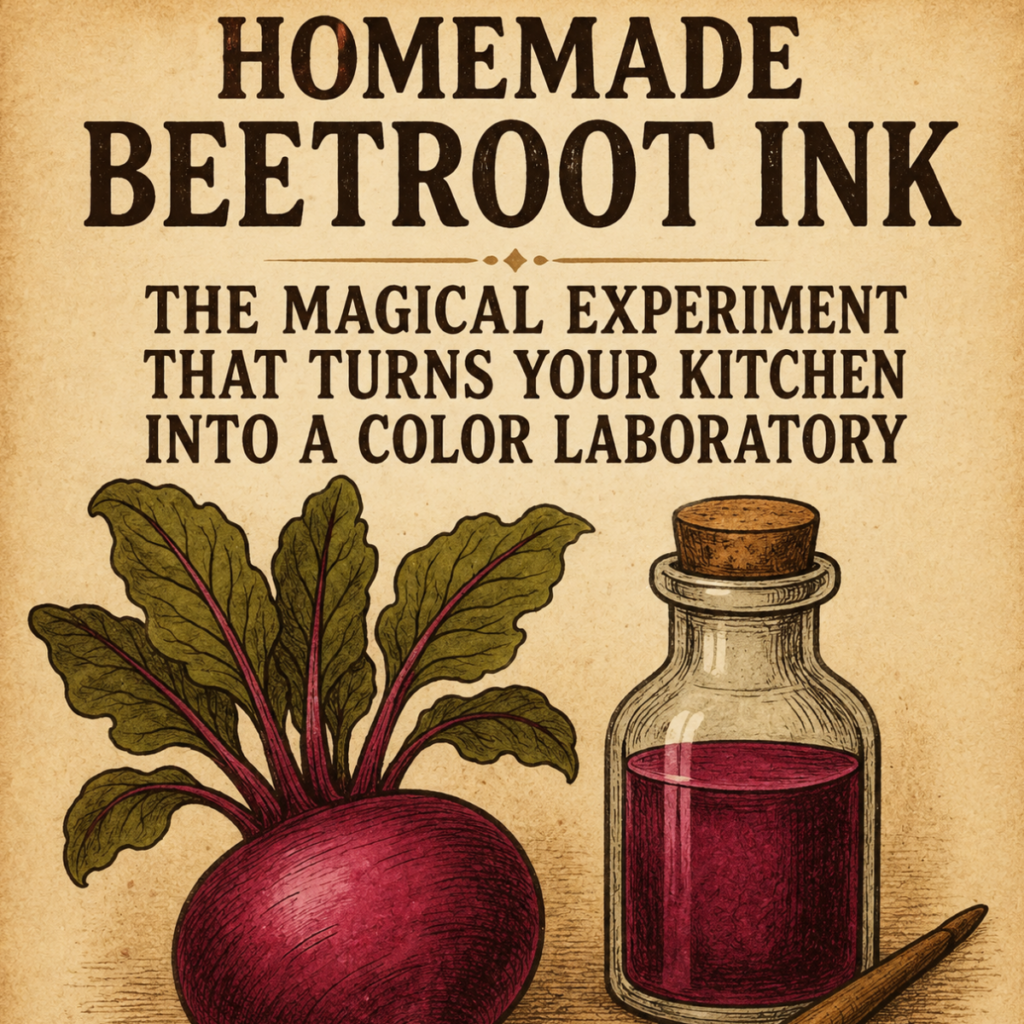
Turn a simple beet into handmade beet ink, with natural shine and amazing magenta tones. Learn step by step how to concentrate the color, stabilize it, and write or paint with your own plant-based ink. Science, art
Beetroot Ink: Fun Science in Your Kitchen
A colorful adventure with betalains, paper, homemade markers, and gentle stovetop heat. No dangerous experiments, just tons of color.
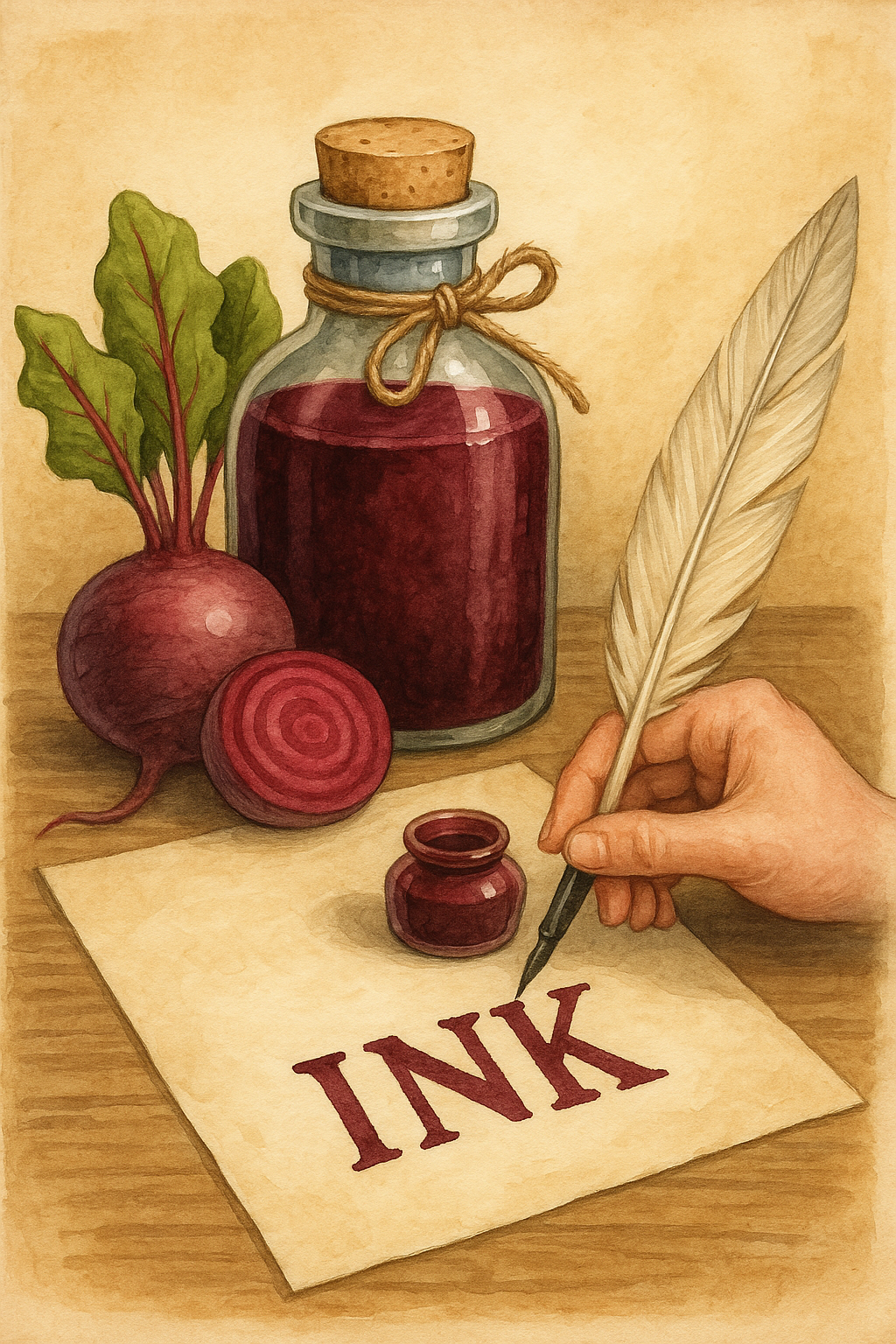 If kitchens could talk, beetroot would shout: “Look at me!”. That impossibly bright, almost theatrical fuchsia has challenged
white shirts and tablecloths since time immemorial. So why not tame that power and turn it into
homemade ink? Welcome to a friendly laboratory where chemistry is explained like a recipe: with teaspoons,
a double boiler, gentle aromas, and results guaranteed to make you smile. Today you’ll learn how to extract color, stabilize it with
everyday ingredients, adjust its flow with gum arabic, write with dip pens, and make your own homemade markers. And because we love
science here, you’ll experiment with pH, paper, and light to understand why this ink changes its mood depending on the setting.
If kitchens could talk, beetroot would shout: “Look at me!”. That impossibly bright, almost theatrical fuchsia has challenged
white shirts and tablecloths since time immemorial. So why not tame that power and turn it into
homemade ink? Welcome to a friendly laboratory where chemistry is explained like a recipe: with teaspoons,
a double boiler, gentle aromas, and results guaranteed to make you smile. Today you’ll learn how to extract color, stabilize it with
everyday ingredients, adjust its flow with gum arabic, write with dip pens, and make your own homemade markers. And because we love
science here, you’ll experiment with pH, paper, and light to understand why this ink changes its mood depending on the setting.
I. Safety, clothing, and a sense of humor
- Beetroot stains everything: wear an apron and use gloves if you care about the color of your hands.
- Work on a washable surface (baking paper or a plastic tablecloth). Keep a sponge and warm water nearby.
- We’ll use gentle heat (a double boiler) to concentrate the liquid without burning it. No high heat.
- The additives (vinegar, salt, gum arabic, and a drop of clove or rosemary as an antioxidant) are kitchen ingredients. Avoid strongly scented additives in ink intended for children.
- The ink is not a drink: even though the ingredients are generally edible, do not ingest it. Label the bottle clearly.
II. The science of fuchsia: why beetroot works so well as ink
Betalains are water-soluble molecules found in beetroot juice. They dissolve easily in water and are sensitive to temperature, oxygen, and pH. Unlike tannins or insoluble pigments, here we’re working with a colorant that behaves like a polite guest: it appreciates the company of a mild acid (vinegar or lemon juice) and a homemade antioxidant (a drop of a very mild clove/rosemary extract or essential oil, or simply a tiny amount of powdered vitamin C).
To turn that juice into ink, we need three things: concentration (evaporating water without “cooking” the color), a binder (gum arabic, which adds body and shine and helps the ink settle on the paper), and conditioners (an acidic pH for stability and a pinch of salt as a mild preservative). That’s how we go from “runaway juice” to “well-behaved ink.”
III. Basic recipe: stable crimson ink (tested version)
Ingredients (for ~60–80 ml of ink)
- 2 medium beetroots (raw) or 300 ml of 100% beetroot juice.
- 1 teaspoon of vinegar (white wine or apple cider) or ½ teaspoon of lemon juice.
- 1 teaspoon of sugar or honey (optional; helps retain moisture and add shine).
- 1 pinch of salt (¼ level teaspoon per 100 ml of total liquid).
- 1–2 teaspoons of powdered gum arabic or 10–15 ml of a 20% solution.
- Optional: 1 drop of food-grade clove or rosemary extract/oil, or a pinch of vitamin C (ascorbic acid).
Equipment
- Grater or blender; fine-mesh strainer or cloth; saucepan and double boiler; small pouring jug.
- Amber glass bottle with lid (80–120 ml) and label.
- Small funnel and coffee filter (if you want the smoothest possible finish).
Method
- Extract the juice: grate the beetroot and squeeze it through a cloth, or blend and strain it. If using commercial juice, shake it well first.
- Acidify: add the vinegar or lemon juice and the pinch of salt. Mix.
- Concentrate in a double boiler: place the juice in a saucepan set inside another pan containing water (don’t let it boil furiously). Allow it to evaporate gently until reduced by 30–40%. Stir occasionally. Avoid prolonged boiling, which dulls the color.
- Give the ink body (binder): dissolve the gum arabic (if using powder, hydrate it in a little of the warm juice until smooth). Add it to the mixture. The ink should remain fluid but have a little body as it flows.
- Antioxidant: add the drop of clove/rosemary or the pinch of vitamin C. Mix.
- Filter and bottle: pass the ink through a coffee filter if you want a silky-smooth finish. Pour into an amber bottle and label it: “Beetroot Ink — date”.
Result: satin-finish magenta ink, ready for a glass pen, dip pen, fine brush, or homemade marker.
IV. Adjusting texture and flow (your precision dial)
More fluid (watercolor, splattering)
- +10–20% distilled water.
- Reduce the gum arabic by 25%.
- Ideal for washes and backgrounds.
Thicker (calligraphy, defined lines)
- Evaporate an extra 10–15% in the double boiler.
- +½–1 teaspoon of gum arabic (to taste).
- Test on paper before making further adjustments.
V. The pH game: from magenta to coral
Betalains change their mood with pH. In an acidic environment, magenta stays bright and pure; if you raise the pH (making it slightly alkaline), the color shifts toward muted purple or brown. To experiment safely:
Acid modifier (maintaining brightness)
Add 1–2 drops of vinegar per tablespoon of ink, mix, and test. Useful if you notice the color becoming dull after a few days.
Alkaline modifier (demonstration only)
Dissolve a pinch of baking soda in water, dip your brush into it, and touch it to the ink on the paper. You’ll see the color shift. Do not store the ink with baking soda: it reduces stability.
VI. Papers, pens, and surfaces: where it looks best
- Cold-pressed watercolor paper (200–300 gsm): absorbs and holds the ink while creating beautiful edges.
- Cotton paper or ~120 gsm sketch paper: a good compromise for notes and sketches.
- Glossy coated paper: takes longer to dry and may smudge; avoid it for calligraphy.
- Glass pen/dip pen: perfect for testing flow; easy to clean under running water.
- Natural fabrics (cotton/linen): the ink will stain them, but it isn’t a permanent washable dye. Ideal for temporary printing.
VII. Homemade cotton marker (for children and curious adults)
Materials
- Cotton swabs or a small piece of rolled-up felt.
- Straw or small tube (for the casing).
- Adhesive tape and your beetroot ink.
Assembly
- Roll the felt to form a “tip.” Insert it into the straw.
- Secure it with tape, leaving 3–4 mm exposed.
- Dip it into the ink, let it absorb the liquid, and start writing!
It’s a capillary-feed marker: perfect for signs, headlines, and dramatically theatrical signatures.
VIII. Fun (and safe) experiments
A) Light and time
Paint three identical squares. Leave one in sunlight, one in the shade, and one stored away. Compare them after 7 and 21 days. You’ll discover how light slowly “washes out” the magenta.
B) Salt and sugar
Make two batches: one with salt (a mild preservative) and another with a little sugar/honey (for shine). Compare their texture and drying time.
C) Wet paper
Dampen an area of the paper and apply the ink: soft-edged washes will bloom across the surface, perfect for botanical illustration.
IX. Stability and storage
Your ink is “alive”: it contains no strong preservatives or organic solvents. Treat it like food in a jar.
- Amber bottle stored in a cool place away from sunlight.
- Label it with the date. Approximate shelf life: 3–6 weeks at room temperature; 2–3 months in the refrigerator.
- If you notice unusual smells or mold, discard it without hesitation.
- For larger batches, bottle the ink in small portions and open them one at a time.
X. Quick table of proportions and effects
| Ingredient | Suggested range | Main effect |
|---|---|---|
| Beetroot juice | 60–80% | Base magenta color |
| Vinegar/Lemon juice | 0.5–2% | Stability / brightness |
| Gum arabic | 2–8% (depending on texture) | Body, adhesion, and finish |
| Salt (mild preservative) | 0.2–0.4% | Slows microbial growth |
| Sugar/Honey | 0–2% | Shine and moisture retention |
XI. Cleaning and stains (the anti-drama manual)
- Countertop/table: paper towel + hot water + soap. If the stain persists, use lemon juice or a little vinegar.
- Fresh stains on clothing: rinse with cold water, then wash with soap. Avoid very hot water at first (it can set the stain).
- Hands: lemon juice and fine salt, gently massaged in, followed by soap. Or embrace your new fuchsia identity for 24 hours. 😄
- Pens and brushes: rinse with warm water and, if any color remains, soak briefly with a drop of soap.
XII. Creative variations (a pantry palette)
Beetroot + blueberries
Use equal parts juice. You’ll get a violet-magenta shade that looks wonderful on cotton paper.
Beetroot + turmeric
Add a pinch of turmeric powder to the batch and coral-orange tones will emerge. Acidify the mixture to prevent a “mustard” hue.
Beetroot + coffee
A splash of strong coffee darkens the color and adds an antique undertone. Useful for shading and aged-looking borders.
XIII. Step-by-step botanical illustration (with your ink)
- Lightly sketch a beetroot with leaves in pencil.
- Apply a light magenta wash to the bulb. Let it dry.
- Add a second, more concentrated layer to the shadows, allowing capillary action to define the edges.
- Leaves: dilute the ink with a tiny drop of turmeric to create an earthy olive green (a color trick). Add veins with a thicker mixture.
- Lift highlights with clean water before the ink is completely dry.
XIV. Frequently asked questions
Can I use it in cartridge fountain pens?
It’s best not to. It can clog the feed and is difficult to clean out. Use glass pens, dip pens, or brushes instead.
Can I use it with stamps?
Yes: thicken it with a little more gum arabic to achieve a stamp pad-like texture. Clean the stamp immediately afterward.
Can I use it to dye Easter eggs or food?
You can use the juice, but not the ink (because of the salt, gum arabic, and concentrated vinegar). If you need food coloring, use plain beetroot juice.
Is the ink waterproof?
Not completely: once dry, it can withstand light splashes, but not heavy washing. That’s part of its watercolor-like charm.
XV. Troubleshooting
It spoils quickly
- Check that the bottle and equipment are clean.
- Add an extra pinch of salt and store it in the refrigerator.
- Make smaller batches.
The color fades
- Add 1–2 drops of vinegar and mix.
- Avoid prolonged exposure to direct light.
- Make sure you haven’t boiled it for too long.
Too thick
- Add distilled water and adjust with a touch of gum arabic if it loses too much body.
Too runny
- Evaporate a little more liquid in the double boiler.
- Or add ¼ teaspoon of hydrated gum arabic.
XVI. The Mad Apothecary’s Field Notebook
“Some inks are born in mines, and others are born in gardens. The first bite into the paper; the second tell it a joke. Beetroot ink belongs to the latter brotherhood.”
XVII. School or workshop project (90 minutes)
Plan
- 15 min — Introduction to betalains and safety.
- 25 min — Extraction and gentle concentration at stations (shared double boiler).
- 15 min — Preparation with gum arabic and bottling.
- 20 min — Paper tests: pH, splattering, washes.
- 15 min — Display and group cleanup.
Each participant takes home a labeled little bottle and a colored postcard. Science that leaves a stain (affectionately) and a lasting memory.
XVIII. A little history (short and friendly)
Plant-based inks were used to color letters and maps long before industrial chemistry took control of color. They can’t compete with mineral blacks or traditional iron-gall inks when it comes to permanence, but they offer something no technical manual can measure: the feeling of making your own creative tool from ordinary ingredients. Beetroot joins a tradition that also includes coffee, tea, berries, and gentle tree barks. A museum of creativity built from kitchen-table leftovers.
XIX. Eco-logic: what to do with leftovers and how to close the loop
- Compost the beetroot pulp or use it in a vegetable soup or purée (as long as you haven’t added salt/sugar at that stage).
- Pour the cleaning water down the sink without drama; just avoid disposing of large quantities containing undiluted gum arabic.
- Reuse bottles: soaking them in hot soapy water removes any remaining color. Boil the lids for 3 minutes to sanitize them.
XX. Quick recipe (20–30 ml) to get started without fear
- 100 ml beetroot juice
- ½ teaspoon vinegar
- 1 pinch of salt
- ½ teaspoon gum arabic (or 5 ml of a 20% solution)
- Optional: the tiniest pinch of vitamin C
- Reduce in a double boiler for 10–15 min (without letting it boil furiously).
- Add the vinegar, salt, and gum arabic. Mix, filter, and bottle.
- Test with a dip pen on cotton paper. Adjust to your liking.
In half an hour, you’ll have enough ink for a title, a postcard, and several signatures with real character.
XXI. Ideas for using it: from notebook to tabletop
- Sign calligraphy for a market stall, with a vintage look.
- Label kitchen jars on kraft paper (coat with diluted PVA glue to protect the label).
- Greeting cards with magenta washes and potato stamps (yes, the classic).
- Color journal: record changes in shade with weather, light, and pH like a true fuchsia naturalist.
XXII. Final thoughts: what you’ll take away (besides a stained tablecloth)
Making beetroot ink teaches you more than a technique: it reminds you that everyday science can fit inside a saucepan; that a color can tell you something about the pH of the world; that paper has a personality; and that a kitchen can also be a laboratory, with simple rules and poetic results. If you go back to buying commercial ink tomorrow, that’s perfectly fine. But now you’ll know that whenever you urgently need a splash of magenta for the title of your own story, you can grate, squeeze, heat, and write. With slightly pink hands and an inevitable smile.
Tags
home laboratory beetroot ink betalains gum arabic calligraphy watercolor safe experiments creative cooking the secret herbalist
Don’t miss the experiments from the secret lab!